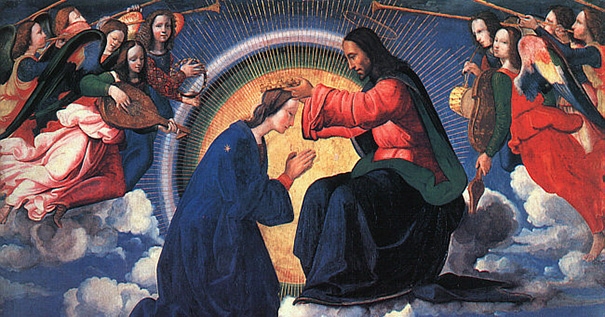
Mary is our Queen, and Her Dominion is Vast

M_Corination of Mary

 08/22/2015

…Yes, Mary’s kingdom is vast, and it includes all of God’s children. That means you and me. She is our Mother, but also our Queen, and as our Queen, we should allow her to reign over our hearts, our work, and our lives…

…On this Feast of the Queenship of Mary (Celebrated August 22nd), perhaps we can re-crown Mary as our heavenly Queen, offering her the honor she deserves and recommitting ourselves to her as her royal subjects. Is there a church or Marian shrine near you? Why not stop in for a quick visit and greet your Queen? Make up a private crowning prayer and symbolically place the golden crown upon Mary’s holy head. You can even do this in the shrine of your heart. Jesus dwells there, and wherever he is, Mary is.

In return, Mary will give you gifts in abundance because it is her special day, and because you are special to her. You are not only her royal subject, but also you are her royal child and she cherishes you as such.

The gifts you receive may not be what you expect, but they will be exactly the ones God wants you to have, through Mary’s royal hands.

BENEDICT XVI GENERAL AUDIENCE

Paul VI Audience Hall
Wednesday, 1 February 2012
Dear Brothers and Sisters,
Today I would like to talk about Jesus’ prayer in the Garden of Olives at Gethsemane. The scenario of the Gospel narrative of this prayer is particularly significant. Jesus sets out for the Mount of Olives after the Last Supper while he is praying together with his disciples. The Evangelist Mark says: “when they had sung a hymn, they went out to the Mount of Olives” (Mk 14:26).
This is probably an allusion to singing one of the Hallel Psalms, with which thanks are given to God for the liberation of the People from slavery and his help is asked for the ever new difficulties and threats of the present. The walk to Gethsemane is punctuated by Jesus’ remarks that convey a sense of his impending death and proclaim the imminent dispersion of the disciples.
Having reached the grove on the Mount of Olives, that night too Jesus prepares for personal prayer. However, this time something new happens: it seems that he does not want to be left alone. Jesus would often withdraw from the crowd and from the disciples themselves “to a lonely place” (Mk 1:35) or he would go up “into the hills”, St Mark says (cf. Mk 6:46). Instead at Gethsemane he invites Peter, James and John to stay closer to him. They are the disciples he called upon to be with him on the Mount of the Transfiguration (cf. Mk 9:2-13). This closeness of the three during his prayer in Gethsemane is important. On that night too Jesus was going to pray to the Father “apart”, for his relationship with the Father is quite unique: It is the relationship of the Only-Begotten Son. Indeed, one might say that especially on that night no one could really have come close to the Son, who presented himself to the Father with his absolutely unique and exclusive identity.
Yet, although Jesus arrives “alone” at the place in which he was to stop and pray, he wants at least three disciples to be near him, to be in a closer relationship with him. This is a spacial closeness, a plea for solidarity at the moment in which he feels death approaching, but above all it is closeness in prayer, in a certain way to express harmony with him at the moment when he is preparing to do the Father’s will to the very end; and it is an invitation to every disciple to follow him on the Way of Cross.
Mark the Evangelist recounts: “he took with him Peter and James and John, and began to be greatly distressed and troubled. And he said to them ‘My soul is very sorrowful, even to death; remain here, and watch” (14:33-34).
In the words he addresses to the three, Jesus once again expresses himself in the language of the Psalms: “My soul is very sorrowful”, an expression borrowed from Psalm 43 (cf. Ps 43[42]:5). The firm determination “unto death” thus calls to mind a situation lived by many of those sent by God in the Old Testament and which is expressed in their prayers. Indeed, following the mission entrusted to them frequently means encountering hostility, rejection and persecution.
Moses is dramatically aware of the trial he is undergoing while guiding the people through the desert and says to God: “I am not able to carry all this people alone, the burden is too heavy for me. If you will deal thus with me, rather kill me at once, kill me if I have found favour in your sight, that I may not see my wretchedness” (cf. Num 11:14-15).
Elijah too finds doing his duty to God and to his People difficult. The first Book of Kings recounts: “he himself went a day’s journey into the wilderness, and came and sat under a broom tree; and he asked that he might die, saying, ‘It is enough; now, O Lord, take away my life; for I am no better than my fathers’” (19:4).
What Jesus says to the three disciples whom he wants near him during his prayer at Gethsemane shows that he feels fear and anguish in that “Hour”, experiencing his last profound loneliness precisely while God’s plan is being brought about. Moreover Jesus’ fear and anguish sums up the full horror of man in the face of his own death, the certainty that it is inescapable and a perception of the burden of evil that touches our lives.
After the invitation to stay with him to watch and pray which he addresses to the three, Jesus speaks to the Father “alone”. Mark the Evangelist tells us that “going a little farther, he fell on the ground and prayed that, if it were possible, the hour might pass from him” (14:35). Jesus fell prostrate on the ground: a position of prayer that expresses obedience to the Father and abandonment in him with complete trust. This gesture is repeated at the beginning of the celebration of the Passion, on Good Friday, as well as in monastic profession and in the ordination of deacons, priests and bishops in order to express, in prayer, corporally too, complete entrustment to God, trust in him. Jesus then asks the Father, if this be possible, to obtain that this hour pass from him. It is not only man’s fear and anguish in the face of death, but is the devastation of the Son of God who perceives the terrible mass of evil that he must take upon himself to overcome it, to deprive it of power.
Dear friends, in prayer we too should be able to lay before God our labours, the suffering of certain situations, of certain days, the daily commitment to following him, to being Christian, and also the weight of the evil that we see within ourselves and around us, so that he may give us hope and make us feel his closeness and give us a little light on the path of life.
Jesus continues his prayer: “Abba, Father, all things are possible to you; remove this cup from me; yet not what I will, but what you will” (Mk 14:36). In this invocation there are three revealing passages. At the beginning we have the double use the word with which Jesus addresses God: “Abba! Father!” (Mk 14:36a). We know well that the Aramaic word Abbà is the term that children use to address their father and hence that it expresses Jesus’ relationship with God, a relationship of tenderness, affection, trust and abandonment.
The second element is found in the central part of the invocation: awareness of the Father’s omnipotence: “all things are possible to you”, which introduces a request in which, once again, the drama of Jesus’ human will appears as he faces death and evil: “remove this cup from me!”.
However, there is the third expression in Jesus’ prayer, and it is the crucial one, in which the human will adheres to the divine will without reserve. In fact, Jesus ends by saying forcefully: “yet not what I will but what you will” (Mk 14:36c). In the unity of the divine person of the Son, the human will finds its complete fulfilment in the total abandonment of the I to the You of the Father, called Abba.
St Maximus the Confessor says that ever since the moment of the creation of man and woman, the human will has been oriented to the divine will and that it is precisely in the “yes” to God that the human will is fully free and finds its fulfilment. Unfortunately, because of sin, this “yes” to God is transformed into opposition: Adam and Eve thought that the “no” to God was the crowning point of freedom, of being fully themselves.
On the Mount of Olives, Jesus brings the human will back to the unreserved “yes” to God; in him the natural will is fully integrated in the orientation that the Divine Person gives it. Jesus lives his life in accordance with the centre of his Person: his being the Son of God. His human will is drawn into the I of the Son who abandons himself totally to the Father. Thus Jesus tells us that it is only by conforming our own will to the divine one that human beings attain their true height, that they become “divine”; only by coming out of ourselves, only in the “yes” to God, is Adam’s desire — and the desire of us all — to be completely free. It is what Jesus brings about at Gethsemane: in transferring the human will into the divine will the true man is born and we are redeemed.
The Compendium of the Catholic Church teaches concisely: “The prayer of Jesus during his agony in the Garden of Gethsemane and his last words on the Cross reveal the depth of his filial prayer. Jesus brings to completion the loving plan of the Father and takes upon himself all the anguish of humanity and all the petitions and intercessions of the history of salvation. He presents them to the Father who accepts them and answers them beyond all hope by raising his Son from the dead” (n. 543). Truly “nowhere else in Sacred Scripture do we gain so deep an insight into the inner mystery of Jesus as in the prayer on the Mount of Olives (Jesus of Nazareth, II, 2011, Ignatius Press, San Francisco, p. 157).
Dear brothers and sisters, every day in the prayer of the Our Father we ask the Lord: “thy will be done, on earth as it is in heaven” (Mt 6:10). In other words we recognize that there is a will of God with us and for us, a will of God for our life that must become every day, increasingly, the reference of our willing and of our being; we recognize moreover that “heaven” is where God’s will is done and where the “earth” becomes “heaven”, a place where love, goodness, truth and divine beauty are present, only if, on earth, God’s will is done.
In Jesus’ prayer to the Father on that terrible and marvellous night in Gethsemane, the “earth” became “heaven”; the “earth” of his human will, shaken by fear and anguish, was taken up by his divine will in such a way that God’s will was done on earth. And this is also important in our own prayers: we must learn to entrust ourselves more to divine Providence, to ask God for the strength to come out of ourselves to renew our “yes” to him, to say to him “thy will be done”, so as to conform our will to his. It is a prayer we must pray every day because it is not always easy to entrust ourselves to God’s will, repeating the “yes” of Jesus, the “yes” of Mary. 
The Gospel accounts of Gethsemane regretfully show that the three disciples, chosen by Jesus to be close to him, were unable to watch with him, sharing in his prayer, in his adherence to the Father and they were overcome by sleep. Dear friends, let us ask the Lord to enable us to keep watch with him in prayer, to follow the will of God every day even if he speaks of the Cross, to live in ever greater intimacy with the Lord, in order to bring a little bit of God’s “heaven” to this “earth”. Many thanks.
Fiat!
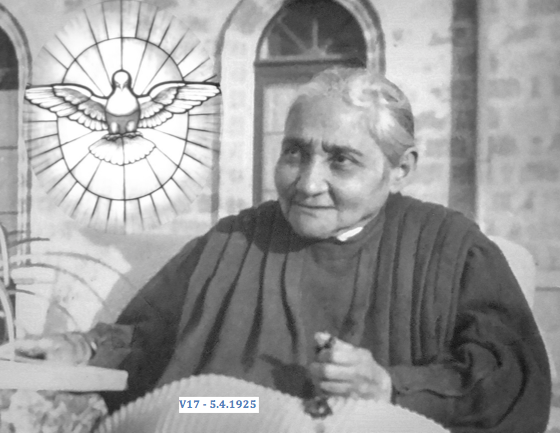
His Holiness Benedict XVI and Luisa Piccarreta

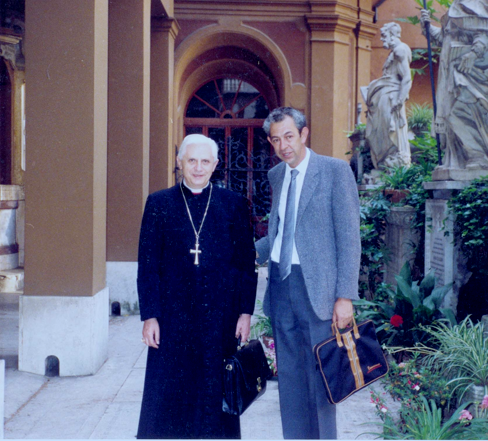
P_Cardinal Ratziner and Mr Acuna
His Eminence and Most Reverend Cardinal Joseph Ratzinger
(Prefect of the Congregation for the Doctrine of the Faith during the Pontificate of His Holiness Pope John Paul II), and José Luis Acuña
Photo provided, and document authored by
Mr. Acuña’s daughter Alejandra Acuña

His Eminence and Most Reverend Cardinal Joseph Ratzinger, Prefect of the Congregation for the Doctrine of the Faith during the Pontificate of His Holiness Pope John Paul II, has been chosen by the Holy Spirit as the Supreme Pontiff of the Holy Roman Catholic and Apostolic Church, precisely in these times in which the Era of the third Divine Fiat begins, as the fulfillment to the petition of the Our Father: ” Adveniat Regnum tuum. Fiat Voluntas Tua sicut in Cœlo et in terra”. And His Holiness Benedict XVI knows about it, as God had prepared him over time making him know and study the writings of Luisa Piccarreta, “The Little Daughter of the Divine Will”, chosen by God for the mission of opening the doors of the Kingdom of the Divine Will on earth as it is in Heaven.

This is the story:

The “Appendix”

       It was in the year 1989 when José Luis Acuña (my father), who lived in Atlacomulco, Mexico, gave to his bishop His Excellency Mons. Ricardo Guízar Díaz, the last book of Don Octavio Michelini that he had translated and published: “The Cup is Overflowing”, with an Appendix written by himself. Four years previously, in 1985, when my dad had bought a house in this diocese to live with us his family, he went to greet our bishop and to introduce himself personally, as he had already been in contact with him once, precisely because of the two previous books of Father Michelini translated and published by him; Mons. Guízar had requested these books for priests of the diocese of Aguascalientes, in which he was the auxiliary bishop, before being made the first bishop of the then recently established diocese of Atlacomulco. Since then they had established a spiritual, cordial and respectful relationship; my dad, together with my mom, Marcela Rincón de Acuña, visited him once in a while and took advantage of this to talk to him about the writings of Luisa Piccarreta and give him some of those he had already translated. In August 1986 His Excellency went to consecrate our private chapel, dedicating it to the Virgin Assumed into Heaven, and every August 15th he would celebrate mass in that chapel.

Mons. Guízar thought that the content of the Appendix was up to date and of great importance, and at the end of 1989 when he made his visit “Ad Limina Apostolorum” – visit that every five years every bishop makes to the Holy Father to inform him about the diocese in his charge- he also made an appointment with the Prefect of the Congregation for the Doctrine of the Faith, ex Holy Office, the Cardinal Joseph Ratzinger, talked to him and gave him the Appendix written by my father, one of his diocesans. The Cardinal looked very interested, because before so many problems and attacks to the Church, inside and outside of Her, he wanted to have a more luminous view of the future of the Church, and the Appendix talked about the attacks and problems of the Church, yes, but also that those attacks are originated precisely by the devil and his partisans to impede or delay in the Church and through Her in the whole world, the Establishment of the Kingdom of God on earth as it is in Heaven, purpose for which the Church was founded by Jesus Christ. However:

“God’s decrees are eternal and there is nothing or nobody that can impede them to be carried out. The creation was an eternal decree and nobody was able, is able or will be able to impede it. The Incarnation and Redemption was an eternal decree and there was nobody able to impede Him fulfilling it. In that same way: THE KINGDOM OF GOD ON EARTH AS IT IS IN HEAVEN is an eternal decree, since Jesus Himself, Eternal Incarnate Word of God, announced It asking for It and making us ask for It, and there is nothing or nobody that can impede Him in this. The harm is for whoever doesn’t want to receive the goods and the fruits of the fulfilment of those decrees, but to impede them…nobody, neither the devil, nor the wickedness of the creature, absolutely nothing or nobody! 

…There is the Magisterium, received from the same mouth of Jesus: “Thy Kingdom come, Thy Will be done on earth as it is in Heaven” and It will come and It will be done… Guided by the Magisterium of our Holy Mother the Church lets open wide the doors of our hearts to the Redeemer and to the Kingdom of God on earth, on us, in us as it is in Heaven, as we know that this Kingdom is the full fruit of the Incarnation of the Word…” (Appendix) 

Interview

Few months afterwards, in May 1990, my parents planned a trip to Italy, to visit the places of Luisa Piccarreta in Corato. Due to the interest shown by Cardinal Ratzinger, my father thought of visiting him in order to tell him more about the Kingdom of the Divine Will in the writings of Luisa; he talked about it with Mons. Guízar and he gave my father a recommendation letter so that Cardinal Ratzinger could receive them.

Once in Italy, they first went to Corato to the House of Luisa, see of the Association “Luisa Piccarreta” founded by Sister Assunta Marigliano; they had an interview with the Archbishop of Trani, Mons. Giuseppe Carata, who had recognized and approved three years before, the Pious Association, and they told him that in Italy they were going to visit His Eminence Cardinal Ratzinger. Mons. Carata told them some interesting facts so that they could mention them to the Prefect Cardinal: that soon they were going to beatify the Venerable Father Annibale Maria Di Francia, Luisa´s extraordinary confessor, Ecclesiastical Censor of the writings of Luisa and first editor of “The Hours of The Passion”, which were published under his responsibility and with his own name, making several editions in Italian and then translated into German and had been placed in the Index of Forbidden Books, and now…. they were going to beatify him?

In the Vatican, my parents were admitted into the private mass of Cardinal Ratzinger and afterwards they approached him. My father as soon as he came out of that interview briefly wrote the main ideas treated with His Eminence:

  • That I was the author of the Appendix. He remembered well the Bishop.
  • I showed him photos of the chapel with him. He told me that this was very important in order to be united with the Church. 
  • I went directly to talk about Luisa and the writings. I gave him the abstracts that I had prepared, which he skimmed through… I explained a little about living in the Divine Volition and the current importance of the writings. 
  • That the Bishop thought they were wonderful.
  • I told him that they hadn’t been approved, that they should be revised. That they were there in the Holy Office. That I was actually not asking this for me, but for so many souls, etc. 
  • He told me that maybe they hadn’t revised them properly (sic). I answered that maybe that wasn’t the time but that now it was, that it is already time; that it is needed to promote them. He told me that he was going to read them attentively. 
  • I also gave him the copies that Sister Assunta gave me and I told him what Mons. Carata told me: about Father Annibale Di Francia; copies of the Hours of The Passion and the Queen of Heaven published by him with his name; they are going to beatify him in October. 

More or less these were the main ideas. He thanked me and said that I should continue to do everything with the Bishop. I said goodbye. 

After that I waited for him outside the chapel to take a picture with him, to put it in the chapel, to which he gladly agreed. I repeated that what pertained to Luisa was VERY IMPORTANT for the Church. He gave us his blessing and we said goodbye. 

In the street I met once again the Personal Secretary, to whom I also spoke about Luisa, who didn’t know, now he knows about her…I will be able to write to him, giving them more writings. 

The Holy Octave of Consecration to God Our Father

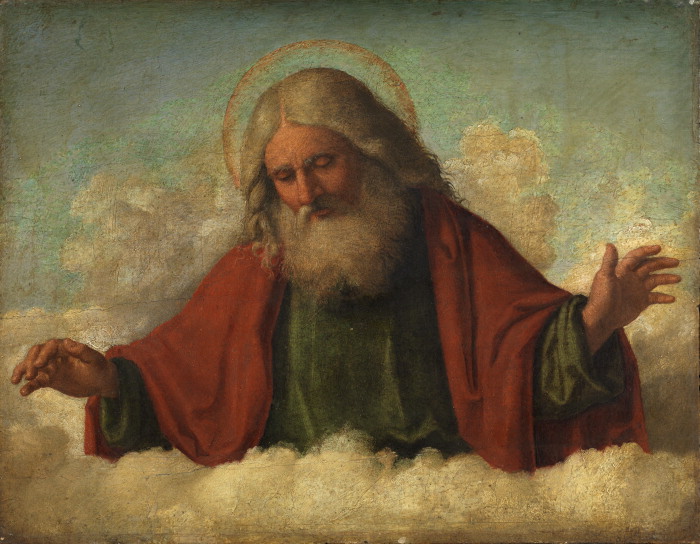
J_God the Father

This year it is from July 25 to August 2

To God Our Father we pray that through The Holy Octave of Consecration and it’s solemn eighth day, The Feast of the Father of All Mankind, He may be known, loved, served and honored by all His children.

Dearest God Our Father, we love You; we adore You; we worship You! 

The Holy Octave of Consecration to God Our Father
to start on Saturday, July 25


For the full text click here

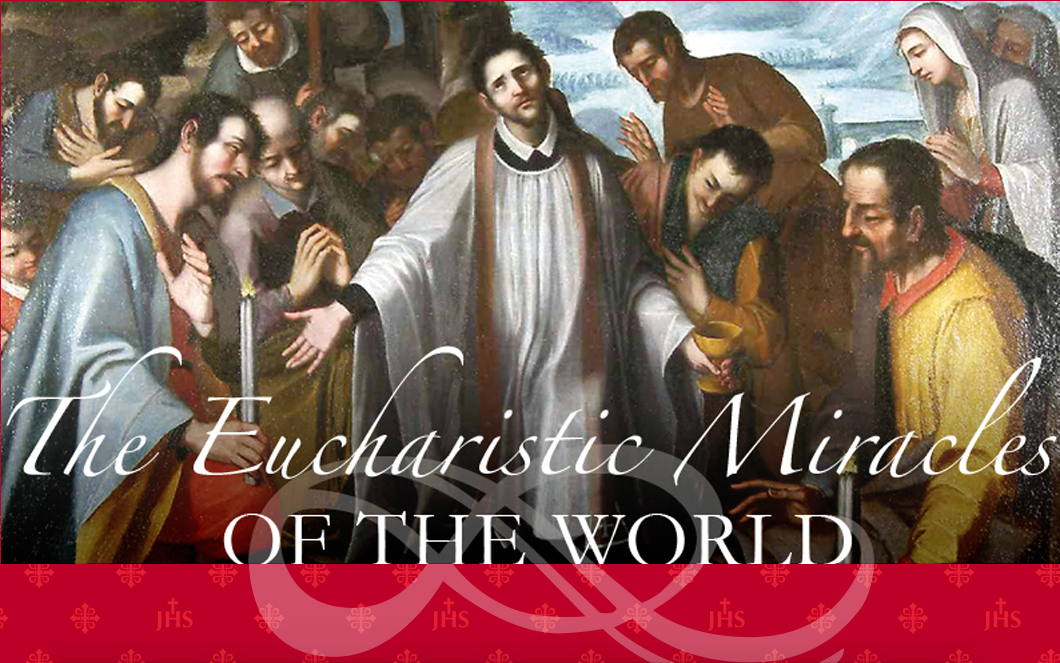
Eucharistic Miracles of the World

Eucharistic Miracles of the World
Click here for the Miracles by Language

The brainchild of young Servant of God Carlo Acutis, an exhibition on Eucharistic miracles, has collected over 130 prodigious facts testifying to the real presence of Jesus in the Eucharist

By Federico Cenci

Rome, July 20, 2015 (ZENIT.org) 

There is a red woven thread of wonder that runs through the history of the Church. An extraordinary event that transcends the laws of nature to show us the heart, the summit, and the core of God’s great plan. This crucial fact, the death and resurrection of Jesus, determines our faith.

From the Andes to the Indian Ocean, through all of Europe and the Middle East, Eucharistic miracles are an invisible bond linking people to the mystery and beauty of God’s presence.

Cataloguing all the miraculous events, throughout history, where the consecrated Host turned into flesh, and the wine into the blood, or when the Sacred Species was saved from desecration, theft, fire is a difficult task. The exhibition on Eucharistic miracles, thanks to a large collection of photographs and abundant historical descriptions, is unique.

About 136 Eucharistic miracles that occurred over the centuries in different countries around the world, and have been acknowledged by the Church, have been collected by this museum that runs through the panels which “virtually” lead us in the places where the events occurred. Already hosted in all five continents, thousands of parishes, 100 universities in the United States and in major Marian shrines throughout the world, the exhibition is the brainchild of the young Carlo Acutis.

Born in London on 3 May 1991 (where his parents used to work) and died in 2006, aged 15, due to a fulminant leukaemia, Carlo focused his short life on developing a friendship with Jesus. Friendship that granted him the strength to face death with amazing courage: minimizing the pain which doctors described as atrocious and deciding to offer them for the good of the Church and Pope Benedict XVI.

A multitude of moved people took part in his funeral. Whoever knew him acknowledged that they met a special teenager. Self-confident, lively, passionate about sport and a computing expert, Carlo had an ability to make himself close to those who suffer, friends or acquaintances. In each he saw the face of the One who is the centre of his affection.

At just 11 years-old he decided to talk about his special bond with the Eucharist. “The more Eucharist we receive, the more we will become like Jesus, so that on this earth we will have a foretaste of Heaven” he wrote. He asked his parents to take him in all the places where the Eucharistic miracles took place. Hence the idea of ​​the creation of this exhibition assumed a primary historical value.

Its organization took about two and a half years. A long, but worthwhile work. As you can read on the website, “The spiritual effects brought about by the exhibition could not have been predicted before its opening.” The initiative’s goodness is underlined by the authoritative foreword of Cardinal Angelo Comastri, Archpriest of the Vatican Basilica, and another from Monsignor Raffaello Martinelli who was, at the time, the Head of the Catechetical Office of the Congregation for the Doctrine of the Faith.

Some recent Eucharistic miracles were added after Carlo’s death. Among these, there is one which happened in Tixtla, Mexico, October 21, 2006, just nine days after the death of the exhibition’s young creator. During a spiritual retreat in the San Martin de Tours parish, during the Communion, the eyes of a priest suddenly grew moist with tears. The celebrant approached him and realized that the Host that this priest had taken to give Communion to a parishioner had begun to pour out a reddish substance.

This caused a sensation and emotion among all the faithful and outside the parish. Scientific research was conducted which ended in October 2012 with the following conclusion: the reddish substance corresponds to AB blood type, similar to that found in the Host of Lanciano and the Shroud of Turin, The blood comes from within, so we must exclude the possibility that someone might have placed it from the outside. The tissue found corresponded to the heart muscle.

In the light of these findings, in 2013 Monsignor Alejo Zavala Castro, Bishop of Chilpancingo, announced in a pastoral letter that “this event brings us a wonderful sign of God’s love, which confirms the real presence of Jesus in the Eucharist.” He said that the case was a “divine sign”.

It was a sign perhaps that this letter was published on October 12, 2013, day of the seventh anniversary of Carlo Acutis’s death — the young man who called the Eucharist “my highway to heaven.” This exhibition is a testament to his friendship with Jesus that Carlo has bequeathed to us all and for which his beatification cause has started.

Click here for the Virtual Museum Page