12/19 O ROOT OF JESSE, 

who stands for an ensign of the people, before whom kings shall keep silence, and unto whom the Gentiles shall make supplication– COME! to deliver us, and tarry not.

5/2/23 – Vol. 15

I felt my poor mind as though dissolved in the immensity of the Eternal Volition, and my sweet Jesus, returning to speak about the Most Holy Will of God, told me:  “My daughter, oh! how well your acts done in my Will harmonize.  They harmonize with mine, with those of my beloved Mama, and one disappears within the other, forming one single act.  It seems that Heaven is on earth, and the earth is in Heaven.  And the echo of one in three and of three in one, of the Sacrosanct Trinity – oh! how sweet it sounds to Our hearing, how it enraptures Us, but so much as to capture Our Will from Heaven to earth.  And when my ‘Fiat Voluntas Tua’ has its fulfillment ‘on earth as it is in Heaven’, then will the complete fulfillment of the second part of the Our Father occur – that is, ‘Give us this day our daily bread.’  I said:  ‘Our Father, in the name of all, I ask You for three kinds of bread every day:  the bread of your Will, or rather, more than bread, because if bread is necessary two or three times a day, this one is necessary at each moment and in all circumstances.  Even more, it must be not only bread, but like balsamic air that brings life – the circulation of the Divine Life in the creature.  Father, if this bread of your Will is not given, I will never be able to receive all the fruits of my Sacramental Life, which is the second bread we ask of You every day.  Oh! how my Sacramental Life feels discomforted, because the bread of your Will does not nourish them; on the contrary, it finds the corrupted bread of the human will.  Oh! how disgusting it is to Me!  How I shun it!  And even though I go to them, I cannot give them the fruits, the goods, the effects, the sanctity, because I do not find Our bread in them.  And if I give something, it is in small proportion, according to their dispositions, but not all the goods which I contain; and my Sacramental Life is patiently waiting for man to take the bread of the Supreme Will, in order to be able to give all the good of my Sacramental Life.  See then, how the Sacrament of the Eucharist – and not only that one, but all the Sacraments, left to my Church and instituted by Me – will give all the fruits which they contain and complete fulfillment, when Our bread, the Will of God, is done on earth as it is in Heaven.

Then I asked for the third bread – the material one.  How could I say:  ‘Give us this day our bread’?  I could do so in view of the fact that, as man would do Our Will, what was Ours would be his, and so the Father would no longer have to give the bread of His Will, the bread of my Sacramental Life and the daily bread of natural life, to illegitimate, usurping, evil children, but to legitimate and good children, who would share in the goods of their Father.  This is why I said:  ‘Give us our bread.’  Then will they eat the blessed bread; everything will smile around them, and Heaven and earth will carry the mark of the harmony of their Creator.

After this I added:  ‘Forgive us our debts, as we forgive our debtors.’  So, charity also will be perfect.  Once man has eaten the bread of my Will as my Humanity ate it, then will forgiveness have the mark of heroism, as I had it on the Cross.  Then will the virtues be absorbed into my Will and receive the mark of true heroism and of divine virtues; they will be like many little rivulets, which will gush forth from the bosom of the great sea of my Will.

And if I added,  ‘And lead us not into temptation’ – how could God ever lead man to temptation? – it was because man is always man, free in himself, since I never take away from him the rights I gave him in creating him; and he, frightened and fearful of himself, tacitly cries out, and prays without expressing it with words:  ‘Give us the bread of your Will, that we may reject all temptations; and by virtue of this bread, deliver us from every evil.  Amen.’

12/18 O HOLY LORD

of the House of Israel, who appeared to Moses in the flame of the burning bush, and gave him the law on Sinai– COME! and redeem us with outstretched arm.

9/3/10 – Vol. 9

As I was in my usual state, blessed Jesus came as a child; …and Jesus, with a light that came out from Him, made me comprehend that when He comes it is always a great good – not only for me, but for the whole world, because by loving one soul and pouring Himself out with her, He comes to regard the whole of humanity. In fact, in that soul there are many bonds that unite everyone: bonds of likeness, bonds of paternity and sonship, bonds of brotherhood, bonds of having all come out and been created by His hands, bonds of having all been redeemed by Him…

12/16 THE “O’S” OF ADVENT

R_O antiphon

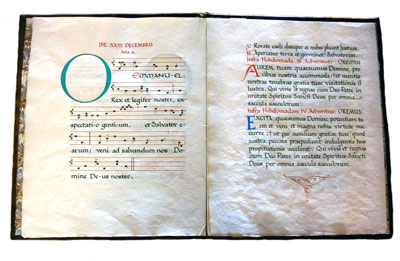
The last seven days before Christmas contain the seven “O Antiphons.”

The “O’s” of Advent are the great gems of liturgical song which are sung each evening at the “Magnificat” at Vespers, from December 17 to December 23. Addressing Christ with seven magnificent titles, they beg Him to come to save His people.

Each O antiphon addresses Christ using a Messianic title drawn from the prophecies of the Old Testament. Read backwards, the initials of each title in Latin form the words Cras ero or “Tomorrow I shall be (with you)”.

Sapientia (Wisdom)
Adonai (Holy Lord)
Radix Jesse (Root of Jesse)
Clavis David (Key of David)
Oriens (Dayspring or Morning Star)
Rex Gentium (King of the Nations)
Emmanuel (God-with-us)

Dec. 17–O WISDOM, who came from the mouth of the Most High, reaching from end to end and ordering all things mightily and sweetly– COME! and teach us the way of prudence.

Dec. 18–O HOLY LORD of the House of Israel, who appeared to Moses in the flame of the burning bush, and gave him the law on Sinai– COME! and redeem us with outstretched arm.

Dec. 19–O ROOT OF JESSE, who stands for an ensign of the people, before whom kings shall keep silence, and unto whom the Gentiles shall make supplication– COME! to deliver us, and tarry not.

Dec. 20–O KEY OF DAVID, and Sceptre of the House of Israel, who opens and no man shuts, who shuts, and no man opens– COME! and bring forth the captive from his prison, he who sits in darkness and in the shadow of death.

Dec. 21–O DAYSPRING, brightness of the light eternal, and Sun of Justice- COME! and enlighten them that sit in darkness and in the shadow of death.

Dec. 22–O KING OF THE NATIONS and their desired One, the Cornerstone that makes both one– COME! and deliver man, whom You formed out of the dust of the earth.

Dec. 23–O EMMANUEL, our King and Lawgiver, the expected of the nations and their Savior– COME! to save us, O Lord our God.

Below is the text of Archbishop Carlo Maria Viganò’s video speech to Saturday’s Jericho March


JERICHO MARCH
“LET THE CHURCH ROAR!”
December 12, 2020

Dear brothers and sisters,

I greet all of you on this day dedicated to prayer for our beloved Nation, the United States of America. Let’s ask God to make truth and justice triumph! Let’s ask Him to dispel the lies and deceptions of the children of darkness!

You have organized these marches in many cities in America, and named them after a Biblical event: the siege of Jericho. Jericho was the first city that the people of Israel came to after they crossed the Jordan River and entered the Promised Land. The way that God commanded the Hebrew people to conquer Jericho shows us the wonderful ways of the Lord, which are so different from our ways! The Book of Joshua tells us that Jericho was walled up and completely closed – it appeared to be an impregnable fortress! It appeared that a long siege would be necessary to conquer it by hunger, or else that huge weapons of war would be needed to break down its walls. And yet the only thing God commanded was that the people walk around the city with the Ark of the Covenant, blowing the Jubilee Trumpets, as the soldiers and people followed in perfect silence, for seven days.

God did not want to make the city of Jericho fall immediately, in order to show mercy to its inhabitants and invite them to do penance. As Saint John Chrysostom says, “The Lord, who took six days to create the heavens and the earth, took seven days to destroy a sinful city.” The Jubilee Trumpets that sounded around the city were used by the Jews to announce pardon and forgiveness. God would not have made them sound without an ending that was full of goodness. In the same way, an ending that is full of goodness inspires our prayer today, for our Country and for our President!

Even the little children walked with their mothers around the city: those little ones were the most chosen portion of all, because they embodied the innocence that overwhelmed wickedness. Thus, moral strength fought against brutal violence, faith fought against unbelief, obedience fought against arrogant rebellion, humility fought against pride, and faith in the Lord fought against the presumption of man. God revealed the superiority of the power of Good over the power of Evil through an astonishing intervention.

We too, in this hour of great tribulation for our Nation, are praying that truth will triumph over lies, justice over abuse and fraud, honesty over corruption, honor over infamy, faithfulness over betrayal, and that order will triumph over destruction.

We are the silent army of the children of Light, the humble ranks who overthrow evil by invoking God, the praying army that walks around the walls of lies and betrayal in order to bring them down.

We fight the battles of the Lord with faith and courage, carrying the Ark of the Covenant in our hearts, remaining faithful to the teachings of the Gospel of Our Lord! We do not need material strength to fight, because we have the Lord of Armies at our side! Nothing can resist the power of the prayer. The walls of the Deep State, behind which evil is barricaded, will come crashing down!

Jericho was also the place where Jesus Christ converted the tax collector Zaccheus (Luke 19: 1-10). We pray for the conversion of public officials who have become complicit in public fraud and have betrayed their oath to serve our Nation.

Along the road that led from Jerusalem to Jericho, the Good Samaritan stopped to help and care for the traveler who was attacked by robbers (Luke 10:25-37). May his fraternal charity be an example for Patriots who are called to serve our homeland that has been attacked and wounded by both internal and external enemies.

It was also in Jericho that the Lord healed Bartimaeus of his blindness (Mark 10:46-53). May the blind man’s faith spur us on to conversion, so that we place our trust once again in God and that He may hear the cry of our prayer for our beloved Nation.

We are citizens of Heaven: this is the homeland that awaits us for eternity. On this earth we are also children of a homeland that gave us birth and in which we were raised and educated, a homeland we have served with dedication and courage. Be proud, as Christians and as Patriots, to be able to give witness today to your faith in God and your love for the United States of America, for its Constitution, and for its President Donald J. Trump.

Let us pray…

O Lord, Almighty God, prostrate before Thee we invoke Thy powerful protection in this hour of great turmoil, when darkness seems to be spreading over our beloved Nation.

Make vain the assaults of those who, blinded by vice and hatred of Thee, wish to subject our Nation and the whole world to the tyranny of sin and rebellion. Grant wisdom and courage to those who are called to decide the fortunes of the United States of America, and to those who serve their country with fidelity and honor.

Lord, bless our President and our public officials. For those who exercise the power entrusted to them from above, obtain the graces necessary to carry out their duties with integrity and justice.

O Almighty God, who many times hast manifested the power of Thy right hand at the side of Christian armies, place Thyself at the head of this army of Thy children. Let the prayer we address to Thee through the intercession of Our Lady of Guadalupe, the Patroness of the Americas, rise up to Thee, so that we may attain the freedom and peace that Thou hast promised us.

And just as in the time of Joshua, raise up holy heroes and courageous witnesses of the Faith, so also today hear the prayer we raise to Thee, and break down the walls of the City of darkness, granting victory to those who serve under Thy holy banner. Amen.

ONE NATION UNDER GOD

+ Carlo Maria Viganò, Archbishop
Former Apostolic Nuncio in the United States of America

GOD BLESS OUR PRESIDENT

GOD BLESS THE UNITED STATES OF AMERICA

ONE NATION UNDER GOD

+ Carlo Maria Viganò, Archbishop
Former Apostolic Nuncio in the United States of America

12/8 Pope Francis proclaims “Year of St Joseph”

Click here for website

With the Apostolic Letter “Patris corde” (“With a Father’s Heart”), Pope Francis recalls the 150th anniversary of the declaration of Saint Joseph as Patron of the Universal Church. To mark the occasion, the Holy Father has proclaimed a “Year of Saint Joseph” from today, 8 December 2020, to 8 December 2021.

In a new Apostolic Letter entitled Patris corde (“With a Father’s Heart”), Pope Francis describes Saint Joseph as a beloved father, a tender and loving father, an obedient father, an accepting father; a father who is creatively courageous, a working father, a father in the shadows.

The Letter marks the 150th anniversary of Blessed Pope Pius IX’s declaration of St Joseph as Patron of the Universal Church. To celebrate the anniversary, Pope Francis has proclaimed a special “Year of St Joseph,” beginning on the Solemnity of the Immaculate Conception 2020 and extending to the same feast in 2021.

Church grants plenary indulgence for year of St. Joseph

The Holy Father wrote Patris corde against the backdrop of the Covid-19 pandemic, which, he says, has helped us see more clearly the importance of “ordinary” people who, though far from the limelight, exercise patience and offer hope every day. In this, they resemble Saint Joseph, “the man who goes unnoticed, a daily, discreet and hidden presence,” who nonetheless played “an incomparable role in the history of salvation.”

A beloved, tender, obedient father

Saint Joseph, in fact, “concretely expressed his fatherhood” by making an offering of himself in love “a love placed at the service of the Messiah who was growing to maturity in his home,” writes Pope Francis, quoting his predecessor St Paul VI.

And because of his role at “the crossroads between the Old and New Testament,” St Joseph “has always been venerated as a father by the Christian people” (PC, 1). In him, “Jesus saw the tender love of God,” the one that helps us accept our weakness, because “it is through” and despite “our fears, our frailties, and our weakness” that most divine designs are realized. “Only tender love will save us from the snares of the accuser,” emphasizes the Pontiff, and it is by encountering God’s mercy especially in the Sacrament of Reconciliation that we “experience His truth and tenderness,” – because “we know that God’s truth does not condemn us, but instead welcomes, embraces, sustains and forgives us” (2).

Joseph is also a father in obedience to God: with his ‘fiat’ he protects Mary and Jesus and teaches his Son to “do the will of the Father.” Called by God to serve the mission of Jesus, he “cooperated… in the great mystery of Redemption,” as St John Paul II said, “and is truly a minister of salvation” (3).

Welcoming the will of God

At the same time, Joseph is “an accepting Father,” because he “accepted Mary unconditionally” — an important gesture even today, says Pope Francis, “in our world where psychological, verbal and physical violence towards women is so evident.” But the Bridegroom of Mary is also the one who, trusting in the Lord, accepts in his life even the events that he does not understand, “setting aside his own ideas” and reconciling himself with his own history.

Joseph’s spiritual path “is not one that explains, but accepts” — which does not mean that he is “resigned.” Instead, he is “courageously and firmly proactive,” because with “Holy Spirit’s gift of fortitude,” and full of hope, he is able “to accept life as it is, with all its contradictions, frustrations and disappointments.” In practice, through St. Joseph, it is as if God were to repeat to us: “Do not be afraid!” because “faith gives meaning to every event, however happy or sad,” and makes us aware that “God can make flowers spring up from stony ground.” Joseph “did not look for shortcuts but confronted reality with open eyes and accepted personal responsibility for it.” For this reason, “he encourages us to accept and welcome others as they are, without exception, and to show special concern for the weak” (4).

A creatively courageous father, example of love

Patris corde highlights “the creative courage” of St. Joseph, which “emerges especially in the way we deal with difficulties.” “The carpenter of Nazareth,” explains the Pope, was able to turn a problem into a possibility by trusting in divine providence.” He had to deal with “the concrete problems” his Family faced, problems faced by other families in the world, and especially those of migrants.

In this sense, St. Joseph is “the special patron of all those forced to leave their native lands because of war, hatred, persecution and poverty.” As the guardian of Jesus and Mary, Joseph cannot “be other than the guardian of the Church,” of her motherhood, and of the Body of Christ. “Consequently, every poor, needy, suffering or dying person, every stranger, every prisoner, every infirm person is ‘the child’ whom Joseph continues to protect.” From St Joseph, writes Pope Francis, “we must learn… to love the Church and the poor” (5).

A father who teaches the value, dignity and joy of work

“A carpenter who earned an honest living to provide for his family,” St Joseph also teaches us “the value, the dignity and the joy of what it means to eat bread that is the fruit of one’s own labour.” This aspect of Joseph’s character provides Pope Francis the opportunity to launch an appeal in favour of work, which has become “a burning social issue” even in countries with a certain level of well-being. “there is a renewed need to appreciate the importance of dignified work, of which Saint Joseph is an exemplary patron,” the Pope writes.

Work, he says, “is a means of participating in the work of salvation, an opportunity to hasten the coming of the Kingdom, to develop our talents and abilities, and to put them at the service of society and fraternal communion.” Those who work, he explains, “are cooperating with God himself, and in some way become creators of the world around us.” Pope Francis encourages everyone “to rediscover the value, the importance and the necessity of work for bringing about a new ‘normal’ from which no one is excluded.” Especially in light of rising unemployment due to the Covid-19 pandemic, the Pope calls everyone to “review our priorities” and to express our firm conviction that no young person, no person at all, no family should be without work!” (6).

A father “in the shadows,” centred on Mary and Jesus

Taking a cue from The Shadow of the Father — a book by Polish writer Jan Dobraczyński — Pope Francis describes Joseph’s fatherhood of Jesus as “the earthly shadow of the heavenly Father.”

“Fathers are not born, but made,” says Pope Francis. “A man does not become a father simply by bringing a child into the world, but by taking up the responsibility to care for that child.” Unfortunately, in today’s society, children “often seem orphans, lacking fathers” who are able to introduce them “to life and reality.” Children, the Pope says, need fathers who will not try to dominate them, but instead raise them to be “capable of deciding for themselves, enjoying freedom and exploring new possibilities.”

This is the sense in which St Joseph is described as a “most chaste” father, which is the opposite of domineering possessiveness. Joseph, says Pope Francis, “knew how to love with extraordinary freedom.  He never made himself the centre of things.  He did not think of himself, but focused instead on the lives of Mary and Jesus.”

Happiness for Joseph involved a true gift of self: “In him, we never see frustration, but only trust,” writes Pope Francis. “His patient silence was the prelude to concrete expressions of trust.” Joseph stands out, therefore, as an exemplary figure for our time, in a world that “needs fathers,” and not “tyrants”; a society that “rejects those who confuse authority with authoritarianism, service with servility, discussion with oppression, charity with a welfare mentality, power with destruction.”

True fathers, instead, “refuse to live the lives of their children for them,” and instead respect their freedom. In this sense, says Pope Francis, a father realizes that “he is most a father and an educator at the point when he becomes ‘useless,’ when he sees that his child has become independent and can walk the paths of life unaccompanied.” Being a father, the Pope emphasizes, “has nothing to do with possession, but is rather a ‘sign’ pointing to a greater fatherhood”: that of the “heavenly Father” (7).

A daily prayer to St Joseph… and a challenge

In his letter, Pope Francis notes how, “Every day, for over forty years, following Lauds [Morning Prayer]” he has “recited a prayer to Saint Joseph taken from a nineteenth-century French prayer book of the Congregation of the Sisters of Jesus and Mary.” This prayer, he says, expresses devotion and trust, and even poses a certain challenge to Saint Joseph,” on account of its closing words: “My beloved father, all my trust is in you.  Let it not be said that I invoked you in vain, and since you can do everything with Jesus and Mary, show me that your goodness is as great as your power.”

At the conclusion of his Letter, he adds another prayer to St Joseph, which he encourages all of us to pray together:

Hail, Guardian of the Redeemer,
Spouse of the Blessed Virgin Mary.
To you God entrusted his only Son;
in you Mary placed her trust;
with you Christ became man.

Blessed Joseph, to us too,
show yourself a father
and guide us in the path of life.
Obtain for us grace, mercy, and courage,
and defend us from every evil.  Amen.

By Vatican News

La Redazione
12/8 Statue on Public Display, Rosary and Mass at Rome City


Click here for website

Statue on Public Display, Rosary and Mass at Rome City

Chapel open for pilgrims on Feast of the Immaculate Conception.

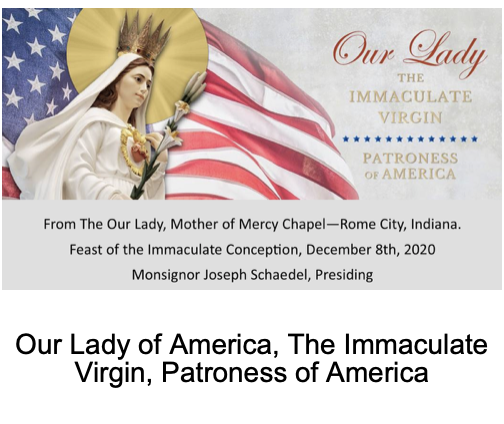
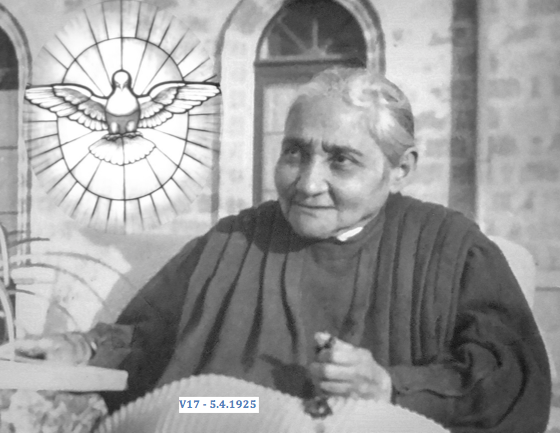
Who is Our Lady of America? Officially, she is Our Lady, The Immaculate Virgin, Patroness of America.   This title “The Immaculate Conception” refers to the dogmatic recognition that the Blessed Virgin Mary was preserved from the stain of any sin, both in her conception and in her life.   This singular privilege was given only to her who was destined to be the Mother of God Incarnate.  This Catholic Doctrine is perfectly in harmony with her wonderful sanctity and preeminent dignity as Mother of God.

Tuesday December 8, we celebrate the Feast of The Immaculate Conception when we recognize her perfect nature. This nature is not only the complete avoidance of sin, but just as importantly, the perfect practice of the virtues. When Sr. Mary Ephrem first received her inspirations in prayer (September 25, 1956), she was drawn to the Immaculate Conception as both a person most worthy of imitation and as our nation’s patroness.

The folks at the not-for-profit Mother of Mercy Foundation which operates the Our Lady, Mother of Mercy Chapel in Rome City, Indiana where Sr. Mary Ephrem first discerned devotion to Our Lady of America has asked us to share this with our list. The Chapel will be open to pilgrims from 9:30 AM to 6:00 PM on December 8th. With the permission of Bishop Kevin Rhoades, the statue of Our Lady of America will be on display in the chapel’s west wing.

If you are able, please join us for the praying of the Angelus and Holy Rosary at noon and at 3:00 PM and Holy Mass is scheduled for 4:30 PM (All time are EST). Please visit PatronessOfAmerica.org for details on visiting the Rome City chapel.  Any last minute changes will be posted there.

Post comments here.