[gview file=”http://luisapiccarreta.co/wp-content/uploads/2016/07/Newsletter-No.-171.pdf”]
Jesus says, “You are gods.” (Jn. 10:34) How is this possible?
PUBLISHED and WRITTEN BY
At baptism, we become “partakers of the divine nature,” (CCC 1265 or 2Pt.1:4) or as St. Athanasius states that we are, “becoming by grace what God is by nature.” The Catechism quotes St. Athanasius to explain this teaching, “For the Son of God became man so that we might become God,” (460) and furthermore it explains, “The only-begotten Son of God, wanting to make us sharers in his divinity, assumed our nature, so that He, made man, might make men gods.” (CCC 460)
For most of us, the concept that “You are gods.”(Jn. 10:34) or that we are being “divinized” is difficult to grasp so let us first look at Jesus’ baptism when the Holy Spirit descends upon Jesus and the Heavenly Father says, “This is my beloved Son, with whom I am well pleased.”(Matt. 3:17) Likewise, the Holy Spirit also descends into our souls at baptism, and we, too, become His sons and daughters as the Psalmist states, “You are ‘gods’; you are all sons of The Most High.” (82:6) The Heavenly Father’s words also apply to us as when St. Faustina hears Him say, “You are My delightful dwelling place; My Spirit rests in you.” (Diary 346)

Our Lady of the Divine Indwelling
St. Paul reminds us that we are temples of God, “Do you not know that your body is a temple of the Holy Spirit within you?” (1Cor.6:19) and “For this reason, those in whom the Spirit dwells are divinized.” (CCC 1988) Divinization also means that the Holy Spirit makes us, “a new creature.”(CCC 1265) However, it is not just the Holy Spirit that dwells in our souls, but it is also the Holy Trinity. The Catechism explains that baptism is the “entry into the life of the Most Holy Trinity,”(1239) and we become “the indwelling of His Presence in us” (2781).

Trinity
St. John Paul II enlightens us that “‘Divinization’…occurs through the admission into the intimacy of the Trinitarian life”, (Novo Millennio Ineunte no. 23) as when the Holy Trinity speaks in the soul of St. Faustina, “‘You are Our dwelling place.’ At that moment, I felt in my soul the presence of the Holy Trinity, the Father, the Son, and the Holy Spirit. I felt that I was the temple of God. I felt I was a child of the Father,”she said. (Diary 451)
St. Faustina says, “Divinize me so that my deeds may have supernatural value,” (1242) but she remains a meek and humble student of the indwelling Presence. She accepts to be molded regardless of her sins and frailties. Jesus explains to St. Faustina what He can do despite our faults and failings, “Your heart is My constant dwelling place, despite the misery that you are. I united Myself with you, to take away your misery and give you My mercy.” (Diary 723) She learns to worship the Holy Trinity within her soul so well that the Blessed Virgin Mary appears to her explaining the divinization going on in her soul, “You are a dwelling place pleasing to the living God; in you, He dwells continuously with love and delight. And the living presence of God, which you experience in a more vivid and distinct way, will confirm you, my daughter, in the things I have told you.” (Diary 785)

Divine Mercy and St Faustina
St. Faustina continues to plead with God, “Divinize me that my deeds may be pleasing to You,” (Diary 1289) so the Blessed Virgin Mary gives her instruction on how to live continually with the indwelling Presence, “My daughter, strive after silence and humility, so that Jesus, who dwells in your heart continuously, may be able to rest. Adore Him in your heart; do not go out from your inmost being. My daughter, I shall obtain for you the grace of an interior life which will be such that, without ever leaving that interior life, you will be able to carry out all your external duties with even greater care. Dwell with Him continuously in your heart. He will be your strength. Communicate with creatures only in so far as is necessary and is required by your duties.” (Diary 785)
Divinization is difficult to understand due to the way we view ourselves, “we hold this treasure in earthen vessels,” (2Cor.4:7) but Instrumentum Laboris instructs us that the “Eucharist is the summit of the Church’s life, since communion with the Lord leads to the sanctification and “divinization” of the person.” (1) Similarly, to help St. Faustina comprehend, Jesus tells her that as she sees Him outside so He is within, “I am dwelling in your heart as you see Me in this chalice.” (1820) But, why is all this relevant or important to us now? Because “The hour is coming when true worshipers will worship the Father in Spirit and truth.” (John 4:23)
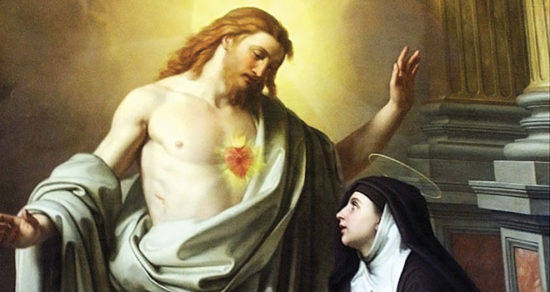
St Marget Mary and the Sacred Heart of Jesus
Yes, the hour is coming very soon when there will be no physical Church to worship in as Pope Benedict XVI explains in the year 2010:
“This passage in chapter 4 of John’s Gospel is the prophecy of a worship in which there will no longer be any temple, but in which the faithful will pray without an external temple in the fellowship of the Holy Spirit and the truth of the Gospel, in communion with Christ; where what is needed is no longer a visible temple but rather the new fellowship with the risen Lord. That always remains important, because it signifies a major turning point in the history of religion as well.”
(Light of the World, pages 16-17)

Inner Light – Source Unknown
Finally, believe and understand that He wants to divinize us not by the “counterfeit divinization of eros,” (Pope Benedict XVI, Deus Caritas Est no. 4) as when the serpent says, “you will be like gods,” (Gen.3:5) but by being humble, intimate, and living temples of God as when Jesus states, “We will come into him, and make Our dwelling in him.” (Jn. 14:23) Therefore, in these turbulent times trust and have confidence that His loving indwelling Presence is always with us day and night to divinize us as Jesus tells St. Faustina, “You are my dwelling place and my constant repose. For your sake I bless the earth.” (Diary 431) ST FAUSTINA PRAY FOR US.
‘Broken Crosses’
clck here for website
CARDINAL BURKE CALLS OUR NATION TO PRAY 54 DAY ROSARY NOVENA
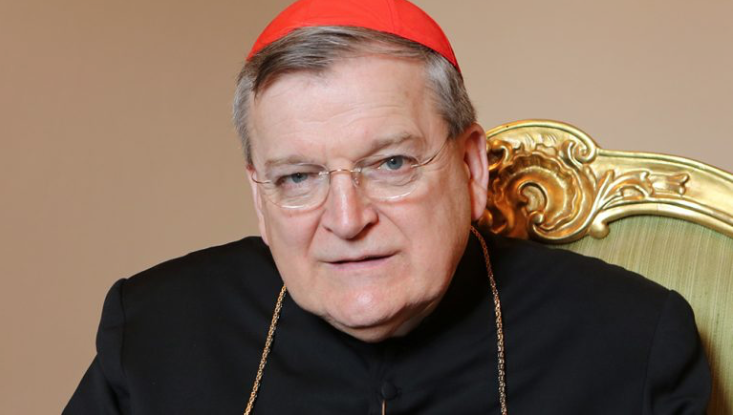
This is the official endorsement of “Novena for Our Nation” by His Eminence, Cardinal Raymond Burke:
“There is no doubt that our beloved nation is in one of the worst crises which it has ever experienced, a profound moral crisis which generates division on all levels and results in an ever-greater more pervasive violence and killing. For Roman Catholics, who have always been known for their faith-filled patriotism, the first response to this crisis is fervent prayer and, in particular, prayer through the intercession of Our Lady of the Holy Rosary, Mary Immaculate who is also the patroness of our nation.
One of the most powerful prayers which is ours in the Church is, in fact, the Holy Rosary. I think, for instance, of the Battle of Lepanto and the victory which was won on October 7, 1571, over the Saracens who were bent on conquering Christian Europe. Let us now turn to the powerful prayer of the Holy Rosary, asking Mary Immaculate to intercede with Our Lord to bring healing to our nation and to inspire in her citizens the holiness of life which alone can transform our nation.
I wholeheartedly endorse the Novena for Our Nation (Starting August 15) and the Rosary Rally on October 7th next, the 445th anniversary of the Battle of Lepanto. I urge as many as are able to participate in these great spiritual works for the sake of our entire nation. In a special way, as the spiritual advisor to the Holy League, I urge all members of the Holy League to give strong leadership in this great campaign of prayer for our nation.”
This is a nationwide prayer campaign called the “Novena for Our Nation.” Everyone from around the nation is encouraged to join ranks as, united, we pray the very powerful 54 Day Rosary Novena from the Feast of the Assumption on August 15 to the Feast of Our Lady of the Rosary on October 7.
For all information, go to novenaforournation.com
Posted July 18, 2016 by romancatholicman.com
Prayers for the Victims and all impacted by the train Crash in the Puglia Region of southern Italy (near Corato)
May God grant Eternal Rest to those who died, and Grace and Healing to the injured and all who are coping with this calamity!
(Click here for more information from UK News)
Jesus tells Luisa 94 years ago today
Vol. 14 – July 10,1922
Now it is necessary that you Luisa to rise (to Heaven)
and carry with you Luisa, My Life, My Divine Will,
so that My Volition of the earth and that of Heaven May Fuse Together,
and you Luisa, may Live for some time in the womb of the Divinity (in Heaven),
where your volition shall be acting in Mine,
in order to expand it as much as a creature can be capable of.
Then, you Luisa, shall descend again upon the earth,
bringing the Power and the Prodigies of My Divine Will on earth,
in such a way that the creatures shall be Shaken,
they shall Open their eyes,
and many shall Know what it means to Live In My Divine Will
– Live In The Likeness to their Creator.
This shall be the Beginning of the Coming of My Kingdom upon earth,
and of the Final Fulfillment of My Divine Will.
Each Kingdom Requires a Lord – Whose Will Reign?
BY GENEVIEVE KINEKE ON JULY 7, 2016 CATHOLIC LIFE, FEATURED
stirling-castle-202103_1280
A few pages of Jesus of Nazareth: From the Baptism in the Jordan to the Transfiguration, by Pope Benedict XVI, has highlighted for me some troubling trends in the Church. He sifts carefully through Catholic thought as it differed historically from extra-ecclesial trajectories, but what must concern today’s reader is that many influential leaders in the Church have accepted non-Catholic premises in their views of the world.
In his explanation of the Kingdom that Jesus preached, Benedict reminds us that Origen had two basic thoughts on the topic. First was that Jesus himself is the “autobasileia, that is the Kingdom in person … the Kingdom is not a thing, it is not a geographical dominion like worldly kingdoms” (p. 49). In this way, those who come to know Christ Jesus come to know God who dwells among them, and who wishes his divine will to prevail.
Origen didn’t stop there, though. He insisted that not only does God dwell with his creatures, but He dwells in them. In a mystical way, it is understood that “man’s interiority [is] the essential location of the Kingdom of God”. And Benedict quotes from Origen’s On Prayer:
“Those who pray for the coming of the Kingdom of God pray without any doubt for the Kingdom of God that they contain in themselves, and they pray that this Kingdom might bear fruit and attain its fullness. For every holy man it is God who reigns … So if we want God to reign in us, then sin must not be allowed in any way to reign in our mortal body … Then let God stroll at leisure in us as in a spiritual paradise and rule in us alone with his Christ” (p. 50).
The two images are not contradictory, but layered, so that Jesus is the kingdom, and Jesus is in the man of virtue, so as that man grasps the grace offered through the passion of Christ, he is both more Christlike and the garden where Christ can reign.
Subsequently, Benedict shows that traditionally there is a third image of the Kingdom, which is the Church:
To be sure, neither the interpretation in terms of man’s interiority nor the connection with Christ ever completely disappeared from sight. But nineteenth- and early twentieth-century theology did tend to speak of the Church as the Kingdom of God on earth; the Church was regarded as the actual presence of the Kingdom within history (p. 50).
Then Benedict explains that the Enlightenment sparked specific trends that proved antithetical to this traditional understanding. There was the radical individualism championed by Adolf von Harnack, and the corollary belief that morality was more important than ritual. Others preferred to see the kingdom in more communitarian terms, pitting ethics against sheer grace, and all of these efforts were upended by Albert Schweitzer’s book, Jesus’ Proclamation of the Kingdom of God. His thesis was still tied firmly to the notion of God and the saving work of Christ, but it was far more eschatological in the sense that it was “a proclamation of the imminent end of the world, of the inbreaking of a new world where, as the term kingdom suggests, God would reign” (p. 52).
Surely the trauma of the First World War led many believers to wonder what place such massive blood-letting among Christians meant in the unfolding of world history, but the accompanying trains of thought went wildly off-course from that point.
Since that time, a secularist reinterpretation of the idea of the Kingdom has gained considerable ground, particularly, though not exclusively, in Catholic theology. This reinterpretation propounds a new view of Christianity, religions, and history in general, and it claims that such radical refashioning will enable people to reappropriate Jesus’ supposed message (p. 53).
Previous shifts of emphasis were not nearly as dangerous theologically as that final lie, which carries the sympathetic soul from a generic theocentrism to regnocentrism without God. And yet that is where we are today in much of the world, ‘where peace, justice, and respect for creation are the dominant values” (p. 54). How many times have we bit our tongues not to “proselytise” (the name of Jesus being so “divisive,” or the boundaries of the Church appearing so threatening)? Benedict acknowledges the temptation:
This sounds good; it seems like a way of finally enabling the whole world to appropriate Jesus’ message, but without requiring missionary evangelisation of other religions. It looks as if now, at long last, Jesus’ works have gained some practical content, because the establishment of the “Kingdom” has become a common task and is drawing nigh (p. 54).
But Benedict ultimately decries this utopian approach which removes God from the mission. The politicisation of the kingdom has marginalised religion, which already must genuflect to the state in so many settings. “This post-Christian vision of faith and religion is disturbingly close to Jesus’ third temptation [in the desert]” (p. 55).
We must keep this in mind as we consider how we approach all government promises in the near future. We see clearly the dangers of hoping that “princes” will advance our pet causes, for those power-brokers can turn on a dime and leave the Christian empty-handed. We must also recognise the dangers of ecumenical endeavors that rejoice in works that are mute about the faith that motivates them. We’ve attempted to baptise so much in the name of tolerance and compassion that we run the risk of losing the meaning of the very names in which we baptise.
Benedict summarises:
When Jesus speaks of the Kingdom of God, he is quite simply proclaiming God, and proclaiming him to be the living God, who is able to act concretely in the world and in history and is even now so acting. He is telling us: “God exists” and “God is really God,” which means that he holds in his hands the threads of the world … “Kingdom of God” is therefore an inadequate translation. It would be better to speak of God’s being Lord, of his lordship (pp. 56-57).
In an upside world where androgyny is to be preferred to man and woman, and “toxic masculinity” is thought to be at the heart of all our woes, we would do well to remember that Lordship has its place–both in the Son of God and those particularly called to live in persona Christi. Kingship carries within it many layered meanings, but primarily the understanding that hierarchy is preferred to mob rule, that sin corrodes the community, and a material kingdom is not what we seek. We cannot allow either the language to be diluted or the mission to be derailed, for Christ must be Lord, now and forever. Amen!
Genevieve Kineke is the founder of Canticle Magazine and the author of The Authentic Catholic Woman. She writes at feminine-genius.com.