[youtube]https://youtu.be/MYUZRfGIW8M[/youtube]
Category Archives: The Divine Will of God
True Crucifixion:
V10 – Nov. 18, 1911 – “You Must Know that True Crucifixion does not consist of being crucified in your hands and feet, but in all the particles of your soul and body. Therefore, I keep you more crucified now than before. How long did the exterior Crucifixion of My Hands and Feet last? Only three hours. But the Crucifixion of All the Particles of My Being, and the Crucifixion of My Will in the Will of the Father lasted for My Whole Life. Don’t you want to Imitate Me in this too?”
True Resurrection:
V36 – April 20, 1938
How Jesus on the Cross still cries to every heart “I thirst.” How the True Resurrection consists in Rising in the Divine Will. How nothing is denied to one who Lives in It.
“…But do you want to know where is the Real Resurrection of the creature? Not in the end of her days, but while she is still living on earth. One who Lives in My Will Rises Again to Light and says: ‘My night is over.’ She Rises Again in the Love of her Creator, so that there is no more cold or snow for her, but the smile of the Heavenly Spring; she Rises Again to Sanctity, that puts in rushed flight all weaknesses, miseries and passions; she Rises Again to all that is Heaven, and if she looks at the earth, Heaven and sun, she does it to find the Works of her Creator—to take the opportunity to narrate to Him His Glory and His long Love Story.
“Therefore, one who Lives in My Will can say, as the Angel said to the holy women on the way to the Sepulcher, ‘He is risen. He is not here any more.’ One who Lives in My Will can also say, ‘My will is not with me any longer—it is Risen Again in the Fiat.’
Newsletter #167 LCDW April 2016
[gview file=”http://luisapiccarreta.co/wp-content/uploads/2016/03/Newsletter-No.-167.pdf”]
3/23 Novena Prayer to St. John Paul II
This year, the anniversary of the death of St. John Paul II falls on the exact day he died 11 years ago, Easter Saturday, (First Saturday) and the day before Divine Mercy Sunday.
Start a novena either on Holy Thursday or Good Friday.

Novena Prayer to St. John Paul II
Oh, St. John Paul, from the window of heaven, grant us your blessing! Bless the church that you loved and served and guided, courageously leading it along the paths of the world in order to bring Jesus to everyone and everyone to Jesus. Bless the young, who were your great passion. Help them dream again, help them look up high again to find the light that illuminates the paths of life here on earth.
May you bless families, bless each family! You warned of Satan’s assault against this precious and indispensable divine spark that God lit on earth. St. John Paul, with your prayer, may you protect the family and every life that blossoms from the family.
Pray for the whole world, which is still marked by tensions, wars and injustice. You tackled war by invoking dialogue and planting the seeds of love: pray for us so that we may be tireless sowers of peace.
Oh St. John Paul, from heaven’s window, where we see you next to Mary, send God’s blessing down upon us all. Amen.(mention your intentions here)
Litany to Saint John Paul II
Kyrie eleison; Kyrie eleison
Christe eleison; Christe eleison
Kyrie eleison; Kyrie eleison
Christ hear us, Christ graciously hear us
God the Father of heaven, have mercy on us
God the Son, Redeemer of the world, have mercy on us
God the Holy Spirit, have mercy on us
Holy Trinity, one God, have mercy on us
Holy Mary, Mother of God, pray for us
St. John Paul II, pray for us
Perfect disciple of Christ, pray for us
Generously gifted with the gifts of the Holy Spirit; pray for us
Great apostle of Divine Mercy; pray for us
Faithful Son of Mary; pray for us
Totally dedicated to the Mother of God; pray for us
Persevering preacher of the Gospel; pray for us
Pilgrim Pope; pray for us
Pope of the Millennium; pray for us
Model of industry; pray for us
Model of priests; pray for us
Drawing strength from the Eucharist; pray for us
Untiring man of prayer; pray for us
Lover of the rosary; pray for us
Strength of those doubting their faith; pray for us
Desiring to unite all those who believe in Christ; pray for us
Converter of sinners; pray for us
Defender of the dignity of every person; pray for us
Defender of life from conception to natural death; pray for us
Praying for the gift of parenthood for the infertile; pray for us
Friend of children; pray for us
Leader of youth; pray for us
Intercessor of families, pray for us
Comforter of the suffering; pray for us
Manly bearing his pain; pray for us
Sower of divine joy; pray for us
Great intercessor for peace; pray for us
Pride of the Polish nation; pray for us
Brilliance of the Holy Church; pray for us
That we may be faithful imitators of Christ; pray for us
That we may be strong with the power of the Holy Spirit;
pray for us
That we may have trust in the Mother of God; pray for us
That we may grow in our faith, hope, and charity; pray for us
That we may live in peace in our families; pray for us
That we may know how to forgive; pray for us
That we may know how to bear suffering; pray for us
That we may not succumb to the culture of death; pray for us
That we may not be afraid and courageously fight off various
temptations; pray for us
That he would intercede for us the grace of a happy death; pray
for us
Lamb of God, you take away the sins of the world, spare us, O
Lord
Lamb of God, you take away the sins of the world, graciously
hear us, O Lord
Lamb of God, you take away the sins of the world, have mercy
on us
Pray for us, Saint John Paul II, That we
may become worthy of the promises of Christ. AMEN
PRAYER FOR THE SICK
Saint John Paul, you invited us to look at the difficult situations in our lives from the perspective of faith, so as to see the mystery of pain’s contribution to our lives. In Jesus, who suffered with us and for us, you have taught us to find meaning and value in the physical and psychological ills that often fill our days and nights. We pray for all those who have suffered the effects of war and for those who carry the burden of illness for a lifetime. We entrust to your prayers those who are in hospitals and nursing homes; people who are disabled or emotionally disturbed; men, women and children who have a terminal illness and who live the Calvary of suffering and loneliness. May those who accompany and care for the sick find their hearts expanded by love. May they recognize in the sick the presence of the poor, crucified Christ. We pray for those who have turned their back on God and faith because of the seemingly unanswerable question of suffering, that they might discover that the mystery of pain can only be understood in Jesus Christ who reveals to us most deeply who we are. In their pain, may they hear the words of the Master: “Follow me.” AMEN.(mention those whom you are praying for who are ill and/or suffering)
Imprimatur: Sean Cardinal O’Malley, O.F.M. Cap., Archbishop of Boston
Mary’s sorrows
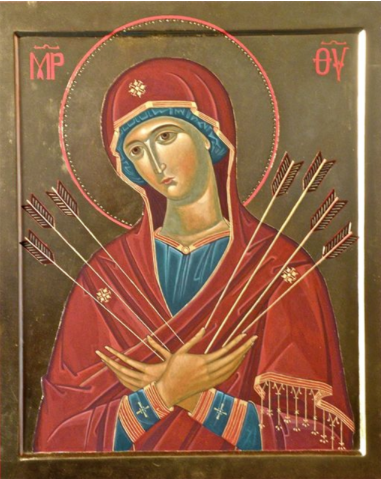
From the OFFICIAL website for the little daughter of the divine will Luisa Piccarreta
The wounds of Jesus and the sorrows of the Blessed Virgin Mary grant the grace of making the human will rise again in God’s Will.
The mystery of the participation of the Blessed Virgin Mary Sorrowful Mother in the passion of her Son is probably the event of the Gospel that has found a wide and intense resonance in popular devotion, in certain pious exercises (Way of the Cross, Via Matris, etc.).
A proof of that religiosity is the famous medieval sequence Stabat Mater Dolorosa (The sorrowful mother stood), attributed to Jacopone that exceptionally became part of the mass formulary. Even if Stabatpraises, with a naive feeling of pity, the pain suffered by the Virgin in the Passion and Death of Jesus, it intensely reflects the essential of the Gospel namely that: “the center of the Christian religion is not in the mourning itself of Mary, but in that “bringing the death of Christ” that the “mater dolorosa” helps to live as an experience. ” [E.. De. Martino]
The sequence is already found in the Franciscan missals of the first half of the 14th century.
Finally Pope Pius X fixed the date on September 15.
In the apostolic Exhortation Marianis Cultus, Paul VI, presented in this manner the memorial of September 15: “the memorial of Our Lady of Sorrows is a perfect occasion to relive a decisive moment in the history of salvation and to venerate together with the Son exalted on the cross the mother who shared His suffering”(n.7).
Contemplating Mary associated with the Passion of the Son, the Church meditates on her own mystery and on her own mystical participation in the sorrows of the Redeemer so that, fruitful of children, she can arrive to the final glory: “Make that the church, uniting herself with Mary to the passion of Christ, be worthy to participate in His resurrection”.
The participation of the passion has two perspectives: personal and communal. It is a continual desire to be free of all form of sin, of evil, individual and social. To take up daily our own cross (Luke 9:39) and to compassionately alleviate the cross of any man or woman we find on our path and of the humanity that we are part of (Luke 10, 25-37; John 13, 34).
The encyclical Redemptoris Mater of St. John Paul II masterfully helps to focus the profound relationship between the peregrinatio fidei of Mary and that of the Church especially at the numbers 23 and 24: “One can say that if Mary’s motherhood of the human race had already been outlined, now (under the cross) it is clearly stated and established. It emerges from the definitive accomplishment of the Redeemer’s Paschal Mystery. The Mother of Christ, who stands at the very center of this mystery-a mystery which embraces each individual and all humanity-is given as mother to every single individual and all mankind. The man at the foot of the Cross is John, “the disciple whom he loved.” But it is not he alone. Following tradition, the Council does not hesitate to call Mary “the Mother of Christ and mother of mankind”: since she “belongs to the offspring of Adam she is one with all human beings…. Indeed she is ‘clearly the mother of the members of Christ…since she cooperated out of love so that there might be born in the Church the faithful”.
And so this “new motherhood of Mary,” generated by faith, is the fruit of the “new” love which came to definitive maturity in her at the foot of the Cross, through her sharing in the redemptive love of her Son. (n.23)
The words uttered by Jesus from the Cross signify that the motherhood of her who bore Christ finds a “new” continuation in the Church and through the Church, symbolized and represented by John. In this way, she who as the one “full of grace” was brought into the mystery of Christ in order to be his Mother and thus the Holy Mother of God, through the Church remains in that mystery as “the woman” spoken of by the Book of Genesis (3:15) at the beginning and by the Apocalypse (12:1) at the end of the history of salvation. In accordance with the eternal plan of Providence, Mary’s divine motherhood is to be poured out upon the Church, as indicated by statements of Tradition, according to which Mary’s “motherhood” of the Church is the reflection and extension of her motherhood of the Son of God. (n.24)
A penetrating gaze on the Virgin, as a model of contemplation is given by Saint John Paul II in his Rosarium Virginis Mariae, where in fact, recalling the milestones of the Mother of Christ, he highlights the look that she was able to address to the Mystery of the Son, therefore becoming herself the model for the adoring contemplation of the believer: “The contemplation of Christ has an incomparable model in Mary. In a unique way the face of the Son belongs to Mary. It was in her womb that Christ was formed, receiving from her a human resemblance which points to an even greater spiritual closeness. No one has ever devoted himself to the contemplation of the face of Christ as faithfully as Mary. The eyes of her heart already turned to him at the Annunciation, when she conceived him by the power of the Holy Spirit. In the months that followed she began to sense his presence and to picture his features. When at last she gave birth to him in Bethlehem, her eyes were able to gaze tenderly on the face of her Son, as she “wrapped him in swaddling cloths, and laid him in a manger” (Luke 2:7).
Thereafter Mary’s gaze, ever filled with adoration and wonder, would never leave him. At times it would be a questioning look, as in the episode of the finding in the Temple: “Son, why have you treated us so?” (Lk 2:48); it would always be a penetrating gaze, one capable of deeply understanding Jesus, even to the point of perceiving his hidden feelings and anticipating his decisions, as at Cana (cf. Jn 2:5). At other times it would be a look of sorrow, especially beneath the Cross, where her vision would still be that of a mother giving birth, for Mary not only shared the passion and death of her Son, she also received the new son given to her in the beloved disciple (cf. Jn 19:26-27). On the morning of Easter hers would be a gaze radiant with the joy of the Resurrection, and finally, on the day of Pentecost, a gaze afire with the outpouring of the Spirit (cf. Acts 1:14).
At number 22 of the same encyclical letter, the Holy Father illustrating the mysteries of sorrow writes: “This abject suffering reveals not only the love of God but also the meaning of man himself. Ecce homo: the meaning, origin and fulfilment of man is to be found in Christ, the God who humbles himself out of love “even unto death, death on a cross” (Phil 2:8). The sorrowful mysteries help the believer to relive the death of Jesus, to stand at the foot of the Cross beside Mary, to enter with her into the depths of God’s love for man and to experience all its life-giving power”.
Therefore Mary is really the model for those who, contemplating the Mystery of God Become Man, effectively deepen the mystery of man and the Paschal Mystery, that is the root of his salvation.
In confirmation of all this there is the testimony of Luisa, who considered the contemplation of Jesus’ Passion and Mary’s sorrow as a fundamental point of reference for her spiritual experience.
Sharing Mary’s sorrow in seeing his Son dying on the cross is not simply sitting back and watch to grieve, but as Luisa teaches us, accompanying our Celestial Mother in her sorrow to participate in the fruits that are ripened from the Passion for the salvation of souls.
In a passage from her diary, dated September 17, 1905 Luisa, in the day of the Sorrows of Mary Most Holy, reports what Jesus said about How one can participate in the sorrows of Mary.
Everyone can share in the merits and in the goods produced by the sorrows of Mary Most Holy. One who, in advance, places herself in the hands of Providence, offering herself to suffer any kind of pains, miseries, illnesses, calumnies, and everything which the Lord will dispose upon her, comes to participate in the first sorrow of the prophecy of Simeon. “Simeon blessed them and said to Mary his mother, ‘Behold, this child is destined for the fall and rise of many in Israel, and to be a sign that will be contradicted (and you yourself a sword will pierce) so that the thoughts of many hearts may be revealed’” (Luke 2:34-35).
One who actually finds herself amid sufferings, and is resigned, clings more tightly to Jesus and does not offend Him, it is as if she were saving Him from the hands of Herod, keeping Him safe and sound within the Egypt of her heart – and she participates in the second sorrow. “When they had departed, behold, the angel of the Lord appeared to Joseph in a dream and said, ‘Rise, take the child and his mother, flee to Egypt, and stay there until I tell you. Herod is going to search for the child to destroy him’” (Matthew 2:13).
One who feels downhearted, dry and deprived of God’s presence, and remains yet firm and faithful to her usual practices – even more, she takes the opportunity to love Him and to search for Him more, without tiring – comes to participate in the merits and goods which The Virgin Mary acquired when Jesus was lost. “When his parents saw him, they were astonished, and his mother said to him, ‘Son, why have you done this to us? Your father and I have been looking for you with great anxiety’” (Luke 2:48).
One who, in any circumstance she encounters, especially in seeing Jesus gravely offended, despised, trampled upon, tries to repair Him, to compassionate Him, and to pray for the very ones who offend Him – it is as if He encountered in that soul His own Mother who, if She could have done it, would have freed Him from my enemies; and she participates in the fourth sorrow. “Daughters of Jerusalem, do not weep for me; weep instead for yourselves and for your children, for indeed, the days are coming when people will say, ‘Blessed are the barren, the wombs that never bore and the breasts that never nursed.’” (Luke 23:28-29).
One who crucifies her senses for love of my crucifixion, and tries to copy the virtues of His crucifixion within herself, participates in the fifth one. “When Jesus saw his mother and the disciple there whom he loved, he said to his mother, ‘Woman, behold, your son.’ Then he said to the disciple, ‘Behold, your mother.’ And from that hour the disciple took her into his home” (John 19:26-27).
One who is in a continuous attitude of adoring, of kissing Jesus’ wounds, of repairing, of thanking etc., in the name of all mankind, it is as if she were holding Him in her arms, just as Mary held Him when He was deposed from the Cross – and she participates in the sixth sorrow. “There were many women there, looking on from a distance, who had followed Jesus from Galilee, ministering to him. Among them were Mary Magdalene and Mary the mother of James and Joseph, and the mother of the sons of Zebedee.” (Matthew 27:55-56).
One who remains in God’s grace and corresponds to it, giving a place to no one else but Him within her heart, it is as if she buried Him in the center of her heart – and she participates in the seventh one. “The women who had come from Galilee with him followed behind, and when they had seen the tomb and the way in which his body was laid in it, they returned and prepared spices and perfumed oils. Then they rested on the sabbath according to the commandment.” (Luke 23:55-56)
My dear Sorrowful Mother,
today, more than ever, I feel the irresistible need to be close to You.
No, I will not move from your side,
to be spectator of your bitter sorrows and to ask You,
as your child, for the grace to place in me your sorrows
and those of your Son Jesus, and also His very death;
so that His death and your sorrows
may give me the grace to make my will die continually,
and make rise again, upon it, the life of the Divine Will.
(Luisa Piccarreta)
[Translation by Antonella]
The Palm Sunday The Passion of Jesus according to Luke
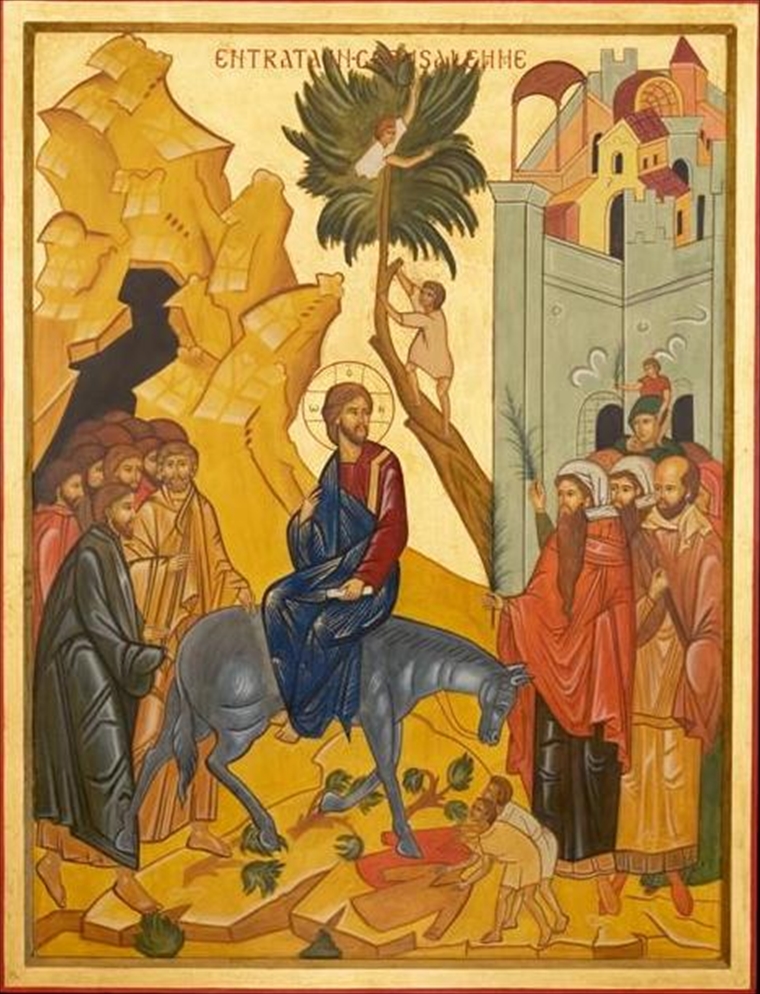
From the Official Website of the Servant of God Luisa Piccarreta
In this comment we will focus briefly our attention on the “treasure of the passion of our Lord that everyone is invited to meditate in order to be fed and saved” as we can read in the Imitation of Christ, a classic of Christian spirituality. After all the slow and simple reading itself of the account of the passion is already an act of faith and a proposal for life, especially in the perspective of Luke’s Gospel.
In fact, the third Evangelist gave an “existential” impression to the plot that he had already received from the most ancient Christian tradition: it is as if he were drawing a path that every disciple must follow in the footsteps of his Lord.
Following Jesus in His passion, the Christian is called to a personal and vital adhesion to be accomplished in Jerusalem, the city that is the destination of the earthly and spiritual journey of Christ and his disciple.
So, Simon of Cyrene and the women of which Luke gave us a very accurate portrayal, were no spectators or neutral witnesses, but they were almost models of those who followed Jesus even in his final and decisive moment. About Simon, Luke noted that “they laid on him the cross to carry behind Jesus” and this expression is normally used by the evangelist to define the commitment of the disciple who “takes up his cross daily” following his Lord even in his final offering.
The women “beat their breasts” and this gesture was repeated at the end of the narrative from the crowds that ” they all went back home, beating their breasts.” This act is a symbolic representation of repentance and conversion that arouse by the appeal of Christ: “Weep for yourselves ….”
Jesus on the cross provided the disciple with another great example to be embodied in life, that of forgiveness of sinners and of offences received: “Father, forgive them for they know not what they do.” It is a lesson that Jesus repeated throughout his life on earth and that the first Christian martyr, Stephen, would welcome and put into practice at the very instant of his death (Acts 7:60).
In this line of complete love, forgiveness and self-giving we can also place the episode, which is reported only by Luke, with the repentant criminal to whom Jesus granted the gift of salvation in the Kingdom. With that sinful man we all have to repeat: “We rightfully receiving the due reward of our deeds, but this man has done nothing wrong.” And with these words of conversion God will throw open the arms of his merciful love also for us.
According to Luke, Christ, even in his death, has become the sign of another way that we must follow, that of perfect abandonment in God’s hands. As it is known, it is only Luke that mentioned another final prayer of Jesus dying on the cross, in addition to the desolate cry of Psalm 22 (“My God, my God, why have you forsaken me?”).
In fact, Jesus quoted the words of Psalm 31 and said: “Father, into your hands I commend my spirit.” It is like the synthesis of a long lesson that Christ spread in Luke’s Gospel on this issue. This means that according to Luke the last word that emerges from the lips of Jesus, is in that “Father!” pronounced at the end with serenity and confidence.
At the end of his Passion narrative, Luke puts a note that at first seems to be marginal “all his acquaintances and the women who had followed Jesus from Galilee saw these events.” Likewise also the crowds converted from the cross of Christ “thought about what had happened. “
At the beginning of the Gospel of Luke, Mary is shown to us as the one who “kept all these things and pondered them in her heart” (2:19.51). Therefore, to understand the deep meaning that is hidden beneath the outer covering of events of Christ’s Passion we must “observe, re-think, meditate.”
Oh Jesus,
your executioners were able to lacerate Your body, insult You, trample upon You…,
but they could touch neither Your Will nor Your love;
these You wanted free, so that, like two currents they might run and run,
without anyone being able to hinder them,
pouring Yourself out for the good of all, and also of Your very enemies.
Oh, how Your Will and Your love triumphed in the midst of Your enemies!
They would strike You with scourges,
and You would strike their hearts with Your love
and with Your Will You would chain them.
They would prick Your head with thorns,
and Your love would turn on the light in their minds to make You known.
They would open wounds on You, and Your love would heal the wounds of their souls.
They gave You death, and Your love gave life back to them;
so much so, that as You breathed your last on the Cross,
the flames of Your love, touching their hearts,
forced them to prostrate themselves before You and to confess You as true God.
Never were You so glorious and triumphant as You were
in Your pains during the course of Your mortal life down here.
Now, in Your likeness, You made the soul free in her will and in her love.
So, others might take possession of the external works of the creature,
but no one – no one can do so with her interior, with her will and her love.
You Yourself wanted her to be free in this,
so that, freely, not being forced,
this will and this love might run toward You
and immersing herself in You, she might offer You
the noblest and purest acts which a creature can give You;
and since You are free, and so is she,
you might pour yourselves into each other and run – run toward Heaven
to love and glorify the Father, and to dwell together with the Sacrosanct Trinity;
run toward the earth to do good to all;
run into the hearts of all to strike them with our love, to chain them with your will, and make of them conquests.
Greater dowry You could not give to the creature.
But where can the creature make greater display of this free will and of this love?
In suffering. In it love grows, the will is magnified,
and, as queen, the creature rules over herself, she binds your Heart,
and her pains surround You like a crown, they move You to pity,
and you let Yourself be dominated.
You cannot resist the pains of a loving soul,
and You keep her at Your side like a queen.
In the pains, the dominion of this creature is so great,
that they make her acquire noble, dignified,
ingratiating, heroic, disinterested manners, similar to Your manners;
and the other creatures compete to let themselves be dominated by this soul.
And the more the soul operates with You, is united with You, identifies herself with You,
the more You feel absorbed in the soul.
So, as she thinks, You feel Your thought being absorbed in her mind;
as she looks, as she speaks, as she breathes,
You feel your gaze, Your voice, Your breath,
Your action, step and heartbeat being absorbed in hers.
She absorbs all of You, and while she absorbs You,
she keeps acquiring Your manners, Your likeness;
You keep gazing at Yourself in her continuously, and You find Yourself.”
(Adaptation from a passage of Luisa’s writings)
So, we need to follow the path of contemplation, reflection, and silence. It’s important to create a space in the liturgy so that the Word of God can enter into our lives and flourish.
don Marco
The agony of Jesus in the garden of Gethsemane (first part)
From the Official Website of the Servant of God Luisa Piccarreta
The prayer of Jesus in Gethsemane (Mark 14:32 to 42) reveals the inner passion of Jesus. The other passages tell us what Jesus suffered and what they inflicted on him, but the event of Gethsemane and Jesus’question to the Father on the cross tell us what Jesus experienced.
The story of the Passion according to Mark begins and ends by describing this interior torment of Jesus; also under the cross Jesus will revive his inner passion in the question that He screams from the cross: “My God, my God, why have you forsaken me?” (Mk 15:33). The inclusion is a narrative way, to say that what was told at the beginning and at the end there was also “in the middle”.
This inner passion didn’t last a moment, it didn’t happen only in the garden of Gethsemane, but it accompanied all the passion of Jesus. The Gospels are always very sober in revealing the inner world of Jesus. The few times in which they do it, they deserve a lot of attention: the gospel of Mark is one of those moments. In this path also Luisa will help us because it is precisely with the Hours of the Passion, that she introduces us into the inner world of Jesus and says how He lived those moments so important and difficult of his life.
We will try to deeply analyze this passage of Jesus’ prayer and we’ll let Luisa and Emeritus Pope Benedict XVI help us, as Luisa in the Hours of the Passion and in some passages of her writings, meditated on this moment of the Passion of Jesus, and Pope Benedict XVI dedicated his Wednesday audience in February 2012 to the prayer of Jesus in the Garden of Olives, precisely the Gospel of Mark and it is very interesting to note that, in this catechesis, and in other talks of Pope Emeritus, there are some indirect quotes from the Hours of the Passion and other passages of Luisa’s writings.
From the Gospel according to Mark (Mk 14:32-42)
32 Then they came to a place named Gethsemane, and he said to his disciples, “Sit here while I pray.” 33 He took with him Peter, James, and John, and began to be troubled and distressed. 34 Then he said to them, “My soul is sorrowful even to death. Remain here and keep watch.” 35 He advanced a little and fell to the ground and prayed that if it were possible the hour might pass by him; 36 he said, “Abba, Father, all things are possible to you. Take this cup away from me, but not what I will but what you will.” 37 When he returned he found them asleep. He said to Peter, “Simon, are you asleep? Could you not keep watch for one hour? 38 Watch and pray that you may not undergo the test. The spirit is willing but the flesh is weak.” 39 Withdrawing again, he prayed, saying the same thing. 40 Then he returned once more and found them asleep, for they could not keep their eyes open and did not know what to answer him. 41 He returned a third time and said to them, “Are you still sleeping and taking your rest? It is enough. The hour has come. Behold, the Son of Man is to be handed over to sinners. 42 Get up, let us go. See, my betrayer is at hand.”
How can we proceed with reading and learning the message that the Gospel offers us? Let’s start with an overview and then, little by little, let’s delve more deeply until we reach the heart of the story, the most important thing. It is as if we did a spiral path; we will start with some exegetical considerations in order to understand more the passage, then we will delve deep the message of the Gospel through the contribution that our Pope gives us to finally get to Luisa who, through the Hours of the Passion and her writings, allows us to have all the instruments to pray and grasp what the Lord now wants to tell us.
Some general comments on the text
The first thing we have to remember is what Jesus said: “Sit here while I pray.” (v.32) and then later “Remain here and keep watch” (v.34). These are the words that Jesus said to Peter, James and John.
Jesus ended the last supper with his disciples and went to the Garden of Olives to live a strong moment of intimacy with God. He left everyone else and took with him these three disciples. Why these three people? They are the three witnesses chosen and called first to contemplate the suffering of God because of the evil of the world. They are the representatives of the Church that have been chosen by Jesus to be witnesses of an important event.
It is not the first time that Jesus makes this kind of choice; again in the Gospel of Mark, in the story of the raising of Jairus’ daughter, it is said that “he took with him Peter, James and John.” Even when Jesus went up to Mount Tabor, where the Transfiguration took place, the Gospel reminds us that “he took with him Peter, James and John.” If the Gospel presents in these three events the same characters, it means that these events have a particular importance. In fact these are the three times in which Jesus manifests himself in a certain way.
Those who remained there and watched in the Garden of Olives, saw the great mystery; they saw the Passion of our Lord for them; they were called to contemplate the true Passion of Jesus. This is the most difficult moment of the Passion of Jesus. Even in The Hours of the Passion, Jesus confided to Luisa that in reality the sufferings he endured on the cross were nothing compared to the agony that He lived in the Garden of Olives. The true Passion was experienced by him there.
The second element that we have to highlight is that the scene takes place in the night! The Bible speaks of three nights of history, which created the three important days of the History of salvation. The first night is that of the primordial chaos, which we find in the book of Genesis (1), when God created the heavens and the earth and gave them to the man who, because of his sin, had turned away from his Creator. The second night is the fight with Jacob (Gen32: 24-32), when God formed his people of Israel by giving it a name, “Israel.” And the third night is that of the Mount of Olives, when the true Israel gives God his real name: “Abba”, Father! If in the creation God placed the world “beside himself”, the creation is the overflow of God’s love, now God himself “goes out of himself” (ecstasy of love!) and goes to the place much further away: on the mouth of the Son who is going to die on the cross. It is the birth of God in the world and the world in God.
The third element is the reference to the scene of the Transfiguration. If at Transfiguration the Father calls Jesus “Son”; Here, at the moment of “disfigurement” the Son calls him “Father.” Between the two scenes there is a profound unity, because there, on Mount Tabor, Jesus’ humanity allowed its divinity to shine; Here, in the garden, the divinity allowed all its humanity to shine.
Fourth element. The Gospel of Mark doesn’t contains the Lord’s Prayer, not because it ignores it, but since it is a gospel for the catechumens, we can only know God as Father in baptism. But in this particular scene, this prayer is present in its essential parts: Abba Father, your will be done, let us not come into temptation. Mark returns to the Our Father in this scene, revealing “who God is” as we must turn to Him, what is the “center” of the Our Father, and what God has to “work” in us, that is to help us not to fall into temptation.
Jesus wants the company of Peter, James and John. Luisa’s company
Let’s take a step forward in our reflection trying to delve deeper. The Holy Father can help us in this passage. He dedicated to this passage of the Gospel one of his Wednesday catechesis, on February 1, 2012
Pope opened his catechesis saying: “The scenario of the Gospel narrative of this prayer is particularly significant. Jesus sets out for the Mount of Olives after the Last Supper while he is praying together with his disciples.”
These prayers probably allude to those psalms which are called psalms of ‘”Hallel”, psalms of praise that were sung or recited during the preparation for the feast of Passover, with which was exalted the power of God who freed the people from slavery of Egypt and all together they asked to God to assist, as then, his people during hard times. And like every year, for the feast of the Passover, Jesus prepared for that prayer, “but this time – said the Pope – something new happens”.
It seems that Jesus does not want to be left alone. Jesus would often withdraw from the crowd and from the disciples themselves to a lonely place or he would go up into the hills. Instead at Gethsemane he invites Peter, James and John to stay closer to him. They are the disciples he called upon to be with him on the Mount of the Transfiguration. This closeness of the three during his prayer in Gethsemane is important. On that night too Jesus was going to pray to the Father “apart”, for his relationship with the Father is quite unique, it is the relationship of the Only-Begotten Son, but He wants these three apostles to be near him.
In the Hours of the Passion, at the fifth hour, Luisa feels drawn to Jesus, from his wounded heart, He calls her and she runs. She thinks to herself where this force that attracts her to Jesus comes from, perhaps it is state of bitterness in which Jesus is and for this reason He asks for her company… and she flies to Him.
We want to pause in our personal prayer to reflect on this desire of Jesus to live this moment of great suffering, crucial for his life, because that’s where Jesus decided to surrender. A time lived in intimacy with God the Father, and only with Him, because He had to accomplish His will, but He didn’t want to be alone, He wanted the company of his disciples, as in the Hours of the Passion asked for Luisa’s company.
This detail shows that the moment of the Passion was not a private moment, but through these three apostles, representing the Church, each of us is called to be present there. And we, when we see Jesus offering his life, abandoning Himself totally in God and praying God in that way, full of inner sadness, we can review all our sorrows, our sufferings and our fears, as we also see Jesus’ fear.
Almost like a master, Jesus wants to lead us to see how in God’s faith and love we can live our difficult and sad moments of life. It is an invitation to live our “Gethsemane” looking at Jesus’ “Gethsemane”. Jesus, calling his three disciples, calls each of us to see how He faces his Gethsemane, trusting in the Father.
[Translation by Antonella]