[gview file=”http://luisapiccarreta.co/wp-content/uploads/2017/12/December2017.newsletter.23.pdf”]B
12/3 St. Nicholas, co-patron of Bari, Italy along with San Sabino
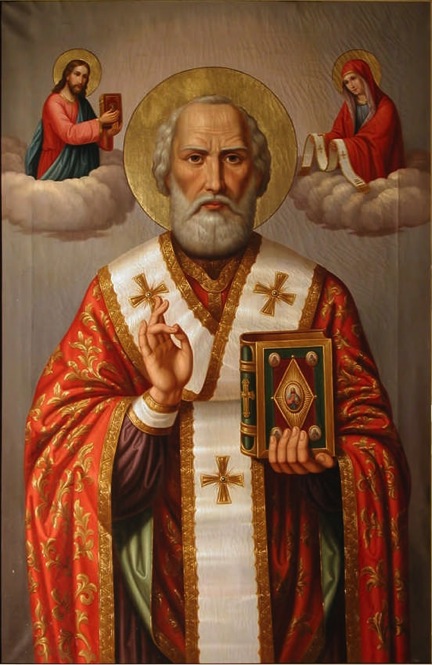
St. Nicholas
Feast Day is December 6th
The charm of Nicholas is fueled by the mystery about his origins, since very little or nothing is known of his family or childhood. He was probably born in Patara in Lycia (today’s Turkey), between 261 and 280, from Epiphanius and Joanna who were affluent Christians. He grew in an environment of Christian faith, but lost his parents prematurely because of the plague, and became therefore a wealthy man. About that period is dated the so-called Miracle of the three girls, masterfully represented by a painting of Sebastian Dayg (1525), as well as by Beato Angelico.
At this point however history fades into legend: a nobleman of Patara had become poor and decided to start his three daughters of marriageable age into prostitution because he could not marry them decently; Nicola learned of that situation and on three consecutive nights threw into the man’s house three cloth bundles full of gold coins, so that the three girls could have a dowry. On the third night the father stayed awake to discover who the benefactor was, but Nicholas asked him not to reveal what had happened. Also for this episode he is revered as a protector of children.
Later on, Nicholas left his hometown and moved to Myra (now Demre, Turkey) where he was ordained as a priest. On the death of the metropolitan bishop of Myra, he was hailed by the people as the new bishop. Imprisoned and exiled in 305 during the persecution by Diocletian, he was later freed by Constantine in 313 and continued his apostolic activity. It is not certain that he was one of the 318 participants at the Council of Nicea in 325: according to the tradition, however, during the Council he condemned Arianism defending the Catholic faith, and in a rush of rage he is said to have slapped Arius. The writings of Andrew of Crete, and Johannes Damascene confirm his faith was rooted in the principles of Catholic orthodoxy.
A famous episode in the life of Nicholas took place when Roman troops commanded by General Nepotianus, Ursus and Erpilion stopped at Myra during an expedition to quell a rebellion in Phrygia. The presence of soldiers in the city created riots, and in the ensuing chaos, the corrupt governor Eustathius agreed to condemn to death the three innocent generals. The execution was stopped by the bishop personally. However, upon their return to Constantinople, the three generals who had quelled the uprising were hailed as winners and this aroused the jealousy of the prefect Ablabius who organized a conspiracy, took them prisoners and sentenced them to death without trial. The three remembered the Bishop of Myra and implored his help: at night Nicholas appeared in a dream to both the prefect and the emperor threatening them of dire punishments if they had harmed the three innocent men. Once released, the three generals went to Myra to say thanks to their savior.
St. Nicholas died at Myra on December 6, presumably in the year 343.
Moral and Theological Virtues
Click here for website
[gview file=”http://luisapiccarreta.co/wp-content/uploads/2017/11/Fr.-Ripperger-Virtues.pdf”]
Video: Msgr. Leonardo D’Ascenzo is the new Archbishop of Trani-Barletta-Bisceglie!
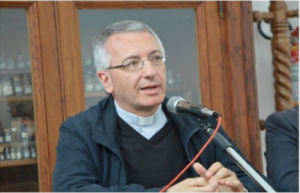
Msgr. Leonardo D’Ascenzo is the new Archbishop of Trani-Barletta-Bisceglie!
Posted on The Associazione Luisa Piccarreta website 11/4/2017
(Click here for article)
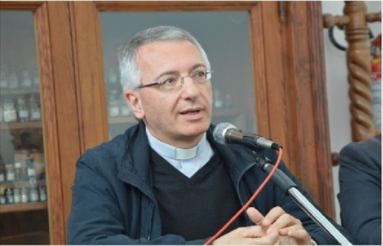
Dear brothers and sisters,
Today, on the feast day of St. Charles Borromeo, the patron saint of seminarians, the Holy Father has appointed as archbishop of Trani-Barletta-Bisceglie, Italy, the Reverend Msgr. Leonardo D’Ascenzo, of the clergy of the diocese of Velletri-Segni, currently rector of the “Pontifical Leonine College” Regional Seminary in Anagni.
Msgr. Leonardo D’Ascenzo was born on 31 August 1961 in Valmontone, province of Rome and diocese of Velletri-Segni. After his high school examinations at the State Technical-Industrial Institute, he entered the “Pontifical Leonine College” Regional Seminary in Anagni for his studies in philosophy and theology, followed by the Pontifical Gregorian University, where he obtained a licentiate in dogmatic theology and a higher degree in science of education. He obtained a doctorate in spiritual theology from the Pontifical “Teresianum” Theological Faculty.
He was ordained a priest on 5 July 1986 for the diocese of Velletri-Segni, and was parish vicar of Santa Maria in Segni, parish priest of Santa Croce in Artena, and parish vicar of the Cathedral of San Clemente in Velletri. He was at first diocesan assistant of Catholic Action for young people and then unitary assistant.
Msgr. Leonardo D’Ascenzo also served as spiritual father, vice-rector and then director of the preparatory year of the “Pontifical Leonine College” in Anagni, director of the centre for vocations, both diocesan and regional, and vice-director of the National Centre for Vocations of the Italian Episcopal Conference.
He is lecturer in spiritual theology at the “Pontifical Leonine College”, and collaborator in the parish of Santa Barbara in Colleferro. On 21 February 2004 he was named Chaplain of His Holiness.
In July 2015 he was appointed as rector of the “Pontifical Leonine College” in Anagni.
We thank the Lord for this great gift He has wanted to do to our Church, and we also ask for the intercession of the Servant of God, Luisa Piccarreta, so that his episcopal ministry can be fruitful and accomplished in the Divine Will!
Fiat!

Australian Man’s Visions, Conversion, Warnings
[gview file=”http://luisapiccarreta.co/wp-content/uploads/2017/11/2017-November-Australian-Man.pdf”]
Saints A to Z
Catholic Online
click here for more information
Below is an example of just one of the many Saints that can be found on Catholic Online: