[gview file=”http://luisapiccarreta.co/wp-content/uploads/2017/08/Newsletter-No.-184.pdf”]
Cardinal Burke Outlines Formal Correction of Pope Francis’ Teaching
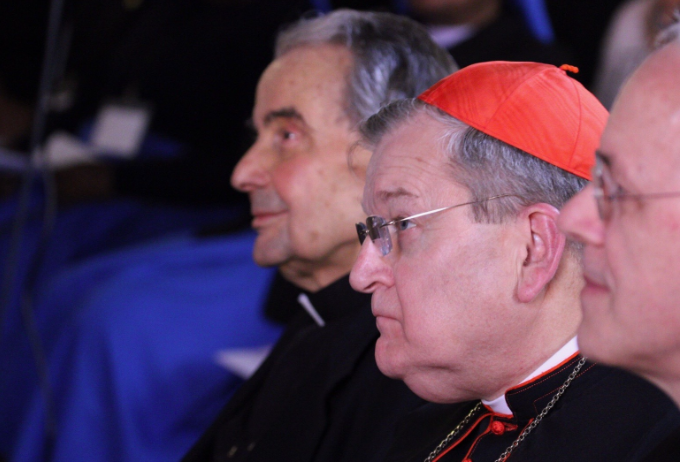
Cardinal Raymond Burke (right) seated next to Cardinal Carlo Caffarra
at the Rome Life Forum, May 19, 2017. (Edward Pentin photo)
The former prefect of the Apostolic Signatura explains in a new interview how a correction of parts of the Holy Father’s magisterium would be enacted, pays tribute to the recently deceased Cardinal Meisner, and stresses the importance of true mercy.
In a new interview, Cardinal Raymond Burke has said it is “now necessary” that a declaration be issued on key areas of Church doctrine that are “not clear” in Pope Francis’ teachings.
The Holy Father will then be “obliged to respond” in order to bring clarification to those teachings, he said.
The cardinal told The Wanderer newspaper Aug. 14 that such a formal act of correction has not been invoked “for several centuries” and until now it has never been used “in a doctrinal way.”
But he said it would be “quite simple” and involve presenting on the one hand the “clear teaching of the Church” and on the other “what is actually being taught by the Roman Pontiff.” The teaching in question in particular relates to doctrinal matters published in the Pope’s 2016 apostolic exhortation, Amoris laetitia.
“If there is a contradiction, the Roman Pontiff is called to conform his own teaching in obedience to Christ and the Magisterium of the Church,” the cardinal explained, adding that a “formal declaration” would be submitted to the Holy Father to which he would be “obliged to respond.”
The cardinal stressed that the dubia, five questions which he and three other cardinals (Cardinals Carlo Caffarra, Walter Brandmüller and Joachim Meisner) issued nearly a year ago, aimed to give the Holy Father the occasion to clarify these aspects of Church teaching.
They were issued in a “very respectful way and not in any way aggressive,” he said, but as the Pope has “chosen not to respond” to them, “so it is now necessary simply to state what the Church teaches about marriage, the family, acts that are intrinsically evil, and so forth.”
“These are the points that are not clear in the current teachings of the Roman Pontiff; therefore, this situation must be corrected. The correction would then direct itself principally to those doctrinal points,” he said.
The cardinal, a former prefect of the Apostolic Signatura, the Church’s highest court, did not give a timeframe for the correction, but hinted at its urgency by stressing that the Church is “being torn asunder right now by confusion and division” and that unity is at stake.
“The Holy Father must be called on to exercise his office to put an end to this,” he said.
Cardinal Burke first suggested a possible formal correction of the Pope in an interview with the Register last November, saying it is “clearly quite rare” but if there was no response, then it would be a “question of taking a formal act of correction of a serious error.” He spoke then of “tremendous division” that is “not the way of the Church.”
In his latest interview, he said he finds the situation “has only worsened” and pointed to groups of lay faithful, priests and bishops he has met who are “practically in desperation” over what is happening.
Any fraternal correction is expected to be undertaken in the first place in camera caritatis, in other words, not in public, according to Cardinal Brandmüller.
In his interview with The Wanderer, the cardinal warned of the danger of schism if universal doctrinal discipline is not restored, but reiterated his firm opposition to that ever happening. “A schism can never be correct,” he said, adding that what is happening is a situation of apostasy that the Blessed Mother warned about in her Message of Fatima.
“There can be apostasy within the Church and this, in fact, is what is going on,” he said. “In connection with the apostasy, Our Lady also referred to the failure of pastors to bring the Church to unity.”
In a speech last month, Cardinal Burke observed that disorientation and error had entered into the Church “in a diabolical way,” but encouraged the faithful to remain steadfast in the faith as well as courageous and serene, knowing Christ’s victory is “already written.”
Cardinal Meisner and true mercy
In his latest interview, the cardinal also praised Cardinal Joachim Meisner, the archbishop emeritus of Cologne and one of the four cardinals to sign the dubia, saying he had a “profound sense of the Catholic Faith” and always “supported and encouraged” those who defended the Church’s “constant teaching and practice.”
“He was a wonderful pastor,” Cardinal Burke said, who never criticized those who supported the Church’s teaching as “legalists” who “do not care about people” and were “throwing stones” at others. “He was a very loving pastor who understood that a good shepherd of the flock must teach the truth to the faithful in its entirety.”
The cardinal also confirmed the existence of a commission to examine Bl. Paul VI’s encyclical Humanae vitae and warned that if the Church’s infallible teaching on contraception (that it “is intrinsically disordered, that to separate the unitive and procreative aspects of the marital act is always and everywhere wrong”) is not upheld, it would “be an opening to all kinds of immoral activity involving our sexual faculties while people would justify sinful genital acts.”
He also stressed the importance of “discriminating mercy” which “distinguishes the sin from the sinner.”
“An expression of love toward the sinner makes it very clear that the sin he or she is committing is absolutely repulsive and must be stopped. Yet, the tendency is to respond with a false sense of mercy,” the cardinal said.
“If we are not conscious of our sin and repenting of it, what does it mean to ask for God’s mercy? Why are we asking for God’s mercy if we have not sinned? So it is as simple as that. Otherwise, mercy is a meaningless term. We must admit the sin we have committed is wrong, that we are deeply sorry for it, and that we are asking for God’s mercy.”
8/5 The Holy Crib

Holy Crib at St. Mary Major Basilica
The Holy Crib
In the crypt under the high altar of the St. Mary Major Basilica llies the celebrated relic known as the Holy Crib. A statue of Pope Pius IX kneeling before the ancient wooden pieces of the manger serves as an example to the faithful who come to see the first humble crib of the Savior. Pius IX’s devotion to the Holy Crib led him to commission the crypt chapel, and his coat of arms is visible above the altar. The precious crystal urn trimmed in silver, through which the faithful can venerate the relic, was designed by Giuseppe Valadier.
Arnolfo di Cambio’s “Crib”
The spiritual and sentimental image of the reconstruction of the “Crib” in remembrance of the venerated event of Christ’s birth, originated in 432 when Pope Sixtus III (432-440) created, within the primitive Basilica, a “cave of the Nativity” similar to that in Bethlehem. Numerous pilgrims returning to Rome from the Holy Land, brought back precious fragments of the Holy Crib (cunambulum), which are now kept in the golden Confessional shrine.
During the following centuries several popes took care of Sixtus III’s Holy Cave, until Pope Nicolò IV in 1288 commissioned a sculpture of the “Nativity” by Arnolfo di Cambio.
Many changes and reconstructions took place in the basilica. When Pope Sixtus V (1585-1590) wished to erect the large Chapel of the Blessed Sacrament or Sistina in the right nave, he ordered the architect Domenico Fontana to transfer, without dismantling, the ancient “cave of the Nativity” with its surviving elements of Arnolfo di Cambio’s sculpture.
The three Magi, dressed in elegant vestments and shoes in a rough gothic style, and Saint Joseph admire with a sense of wonder and reverence the miracle of the Baby in the Virgin Mary’s arms (of P. Olivieri) warmed by the ox and the donkey.
7/30 Effectiveness of the intentions.
Book of Heaven
9/9/01 – Vol. 4
This morning my adorable Jesus was not coming. Then, while my mind was occupied with considering the mystery of the crowning of thorns, I remembered that, other times, as I was occupied with this mystery, the Lord had pleased to remove the crown of thorns from His head and to drive it onto mine. So I said in my interior: ‘Ah, Lord, I am no longer worthy of suffering your thorns.’
And all of a sudden He came, for just a little, and told me: “My daughter, when you suffer my own thorns, You relieve Me, and in suffering them yourself, I feel completely free of those pains. When you humble yourself and believe yourself unworthy of suffering them, you repair for the sins of pride which are committed in the world.”
And I (Luisa) added: ‘Ah, Lord, for as many drops as You shed, for as many thorns as You suffered, for as many wounds, so much glory do I intend to give You for as much glory as all creatures should give You if the sin of pride did not exist; and so many graces do I intend to ask of You for all creatures, so that this sin be destroyed.’
While saying this, I saw that Jesus contained the whole world within Himself, like a machine containing objects in itself. All creatures moved within Him, and Jesus moved toward them, and it seemed that Jesus would receive the glory of my intention and that creatures had returned to Him in order to receive the good impetrated by me for them. I remained stupefied, and He, seeing my stupefaction, said: “All this seems surprising, doesn’t it? What you have done seems a trivial thing, yet, it is not so. How much good could be done by repeating this intention, but is not?” Having said this, He disappeared.
OUR SHEPHERD LEFT FOR OUR FATHER’S HOUSE
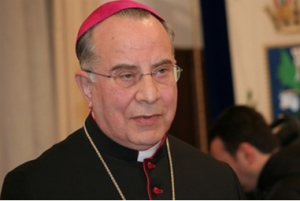
Mons. Giovan Battista Pichierri,
Archbishop of Trani-Barletta-Bisceglie
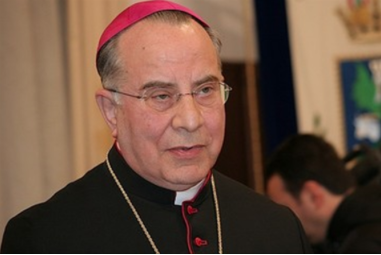
Public announcement of the Archdiocese of Trani-Barletta-Bisceglie
7/27/2017
Today morning, around 8.30 am, Mons. Giovan Battista Pichierri, Archbishop of Trani-Barletta-Bisceglie, was found without life. Probably he was going to wash himself when he was suddenly taken ill. The sisters who lived with him around 8.30, did not see him coming, so they called him, but they made the sad discovery. A priest acted immediately and called for help. The rescues came up promptly, but the various attempts to reanimate him had not any positive effect.
Mons. Giuseppe Pavone, Vicar General, invites the whole ecclesial community to pray “for our Father and Shepherd who was just about to celebrate the 50th anniversary of his priestly ordination, all dedicated to serving the Church.”
During the morning the guesthouse of the Archbishop was the destination of so many people, especially priests and relatives of Mons. Pichierri. The body was arranged and placed in the burial chamber, located in the hall of the second floor of the Archbishop’s palace in Trani. It will remain there until 10.00 on Thursday July 27. Then, it will be transferred to the Church of St. John the Baptist in Trani: here, in the evening, a prayer vigil will take place at 8:30 p.m. and on Friday July 28 at 13.00, the clergy will recite the Little Hours; Subsequently, the corpse will be transferred to the Cathedral of Trani, where the Celebration of the funeral will take place at 4:00 pm. The Holy Mass will be presided over by His Eminence Cardinal Salvatore De Giorgi.
Mons. Giovan Battista Pichierri was born in Sava (Ta) on February 12, 1943. He was baptized on March 6, 1943.
After studying at the diocesan and regional Seminary in Molfetta, he was ordained a priest in the diocese of Oria (BR) on August 30, 1967. He completed his theological education by attending the Ecumenical Theology in Bari, where in 1970 he obtained the degree in Ecumenical Theology.
The first ten years of his priestly ministry were at the service of the Diocesan and Regional Minor Seminaries for the High School in Taranto. In the latter one at first as an animator and then as a rector.
When he returned to the diocese in 1977, he served the diocesan church collaborating directly with Bishop De Giorgi and Bishop Franco, and in the interval of the succession between these two bishops he was delegate “ad Omnia” of the Apostolic Administrator Voto, Bishop of Castellaneta.
Since 1982, Mons. Armando Franco appointed him as an archpriest, and entrusted to him the pastoral care of the Church “Santissima Trinità” in Manduria, that he served until March 12, 1991.
In 1986, Mons. Franco himself called him to cooperate more directly to lead the diocese, entrusting to him the task of Vicar General and Moderator of the Curia.
Throughout the years of his ministry he taught Catholic Religion in State Schools: middle and high School, Gymnasium, Commercial Institutes, Scientific High School.
On 21 December 1990 the Holy Father John Paul II chose him as Bishop of the Diocese of Cerignola-Ascoli Satriano (FG).
On January 26, 1991 he was ordained Bishop in the Mother Church of Manduria (Ta) by the diocesan Bishop, Mons. Armando Franco. On March 17, 1991, he entered the diocese,
On November 13, 1999, the Holy Father John Paul II transferred him to the archbishopric of Trani-Barletta-Bisceglie and Nazareth (Ba).
The entry into the new diocese took place on January 26, 2000, the ninth anniversary of his episcopal ordination.
It is difficult to condense in a few lines a bishopric that was so full of commitment and teaching.
The relevant pastoral documents were about thirty. They, considered in a synoptic view, give an idea of the depth of the pastoral interests he pursued: the guidelines for the permanent diaconate (2000); Statute and rules of the Episcopal Curia (2000); The parish as a cell and pastoral subject (2001), the parish as a missionary eucharistic community (2002), the parish as a missionary ecumenical community (2005); on the instituted ministries. (2002); about family and youth (2002); On engagement (2005); On pastoral visit (2005); On the Institute of Religious Studies (2007); On the formation of the diocesan presbytery (2007); On the importance of listening to the Word of God (2008); On the deeper meaning of the Church as House of Hope (2007) and with a Maternal Face (2008); On the Pastoral Care of Wounded Families (2009), and the list goes on.
His service was multifaceted: for teaching, sanctification, pastoral service, for the cause of ecumenism, creation of charity works in the seven cities of the diocese.
The First Diocesan Synod was his last pastoral choice that he wished and accomplished in several years. It was issued on October 19, 2012, on the theme “For the Church, a mystery of communion and mission”. “It is celebrated under the action of the Holy Spirit” as he used to say at the preparation stages, during the time of reflection and discussion about the instrument of work, and in the election assemblies (2013-2015). The Synod ended on October 30 2015. On January 26, 2016, on the XXV anniversary of his episcopal ordination, he promulgated the Synodal Book. Since then, he worked with his collaborators to realize the guidelines of the Synodal Book: the reform of the curia, creation of a formation school for pastoral workers, establishment of a diocesan service for families in crisis, the summons of a diocesan conference to verify the path accomplished after the synod.
More recently, he was preparing for the celebration of the fiftieth anniversary of his priestly ordination, in the name of sobriety and prayer. For that occasion he wanted to send to the diocesan community a letter that will be made known in a few days, in which, among other things, he wrote:
“We have come to the time of physical farewells: on February 12, 2018, I will be 75 years old and, according to Can. 401 of the Code of Canon Laws, I am required to put the episcopal mandate into the hands of the Holy Father Francis. I do this with serenity of spirit and as a act of love towards the Holy Church of Trani-Barletta-Bisceglie, so that it can continue to grow in Jesus Christ, our good and beautiful pastor, under the guidance of the one whom the Holy Father will elect and send as my successor. What I feel I have to write to you is not my last will, but a warm exhortation to remain in God’s love, just as our teacher Jesus asks us: “Remain in my love!” (John 15: 9) . (…) About pastoral commitment: Please consider the diocesan synod we celebrated as the “magna carta” to follow, for the diocesan pastoral ministry, improving it, step by step under the new guidance of the Archbishop who you will have as a gift .
Beloved, let the Archbishop, my successor, know what we experienced in Christ Jesus under the action of the Holy Spirit, through your synodal ecclesial lifestyle. The new Shepherd will come to serve and grow with you ‘by every supporting ligament ‘(Ephesians 4:16) of the mystical body of Christ. “
And, in an interview with the monthly diocesan “In Communion,” when he was asked if he wanted to talk about a subject he had not been asked before, he said:
“I leave the Archdiocese of Trani-Barletta-Bisceglie to enter my diocese of origin, Oria, and live in my native town, Sava. I have a” dream “that I wish and ask the Lord to be able to accomplish it: to work to return the presence of consecrated people to Sava. Let me explain. In Sava, there were the minor Franciscan friar who had created some works of charity. The Sisters of Charity of St. Vincent and St. Luisa de Marillac who had thaught many generations of children and girls in the “Daughters of Mary”, and had taken care of the poor by helping the “Ladies of Charity”; The Daughters of Mary Help of Christians, worthy for the equalized primary and secondary school. Now, Sava, is lacking in the precious presence of Consecrated Life. So, with the help of God and the cooperation of the brothers and sisters who are engaged in associations and volunteering, supported by the Diocesan Bishop and civil authorities, I would like to set up a ” House of Tenderness ” in a significant place in the city and entrust it to a community of consecrated life, held by myself, by the priests of the city, by the Volunteers. That would be a miracle! Therefore, I ask the prayer of the beautiful diocesan church of Trani-Barletta-Bisceglie that I carry in my heart. Thank you!”
Newsletter dell’Ufficio Stampa Diocesano e Comunicazioni Sociali
7/28 Victim souls are the daughters of Mercy.
Book of Heaven
6/20/04 – Vol. 6
After I struggled very much, blessed Jesus came for just a little and told me: “My daughter, human perfidy has reached such a point as to exhaust my Mercy on its part. But My (God’s) Goodness is so Great as to constitute daughters of Mercy, so that on the part of creatures also, this attribute may not be exhausted. These are the victims who are in full ownership of the Divine Will, having destroyed their own. In fact, in these souls, the container given by Me in creating them is in full vigor, and since they have received the particle of My Mercy, being daughters, they administer it to others. It is understood, however, that in order to be able to administer the particle of My Mercy to others, they themselves must be in Justice.”
And I: “Lord, who can ever be in Justice?”
And He: “The one who does not commit grave sins and abstains from committing the slightest venial sins of his own will.”
The Archbishop of Trani-Barletta-Bisceglie, Mons.Giovan Battista Pichierri left for the Father’s house
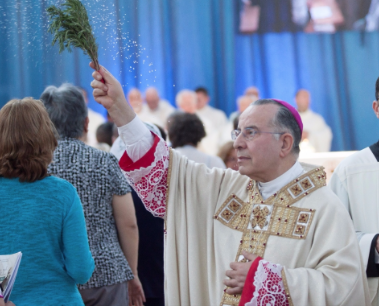
Mons. Giovan Battista Pichierri
Dear friends in the Divine Will, this morning (July 26, 2017), the Archbishop of Trani-Barletta-Bisceglie, Mons. Giovan Battista Pichierri left unexpectedly for the Father’s house. The funeral will take place at 4:00 p.m on July 28 at the Cathedral of Trani.
We are waiting to hear more news. Meanwhile we want to express on behalf of the members of the Association Luisa Piccarreta Little Children of the Divine Will in Corato and of the whole “Family of the Divine Will” in the world our thanks to God for all that He gave to us through the love and care of this Shepherd.
He has always accompanied, encouraged and supported us. May the Lord give him the reward of the “faithful servants”!
We are certain that Luisa will welcome Him in Heaven and lead Jesus to Jesus. Let us pray for him in the Divine Will.
Fiat Fiat Fiat
Il Presidente Michele Colonna e l’ Assistente Ecclesiastico d. Sergio Pellegrini