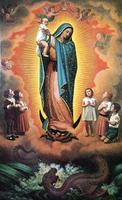
The Real Presence in the Eucharist . . .
. . . and the real presence in the Womb
[youtube]http://youtu.be/zgF4LJk1G9s[/youtube]
Accessibility Tools
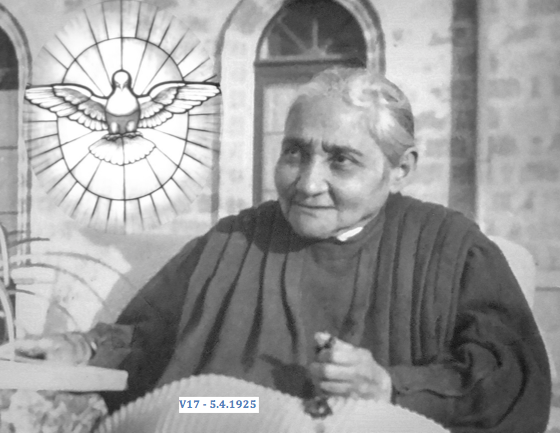
The Real Presence in the Eucharist . . .
. . . and the real presence in the Womb
[youtube]http://youtu.be/zgF4LJk1G9s[/youtube]
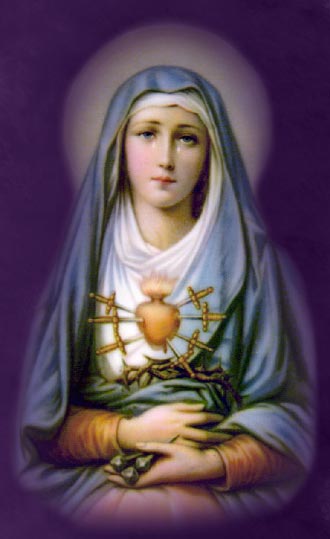
| The Blessed Virgin Mary grants seven graces to the souls who honor her daily by saying seven Hail Mary’s and meditating on her tears and dolors (sorrows). The devotion was passed on by St. Bridget. HERE ARE THE SEVEN GRACES:
Mater DolorosaSEVEN SORROWS
|
| The Angelic Salutation (Hail Mary) Hail Mary, full of grace, the Lord is with thee; Blessed art thou amongst women, and blessed is the fruit of thy womb, Jesus. Holy Mary, Mother of God, pray for us sinners, now and at the hour of our death. Amen. |
Salutatio Angelica (Ave Maria) Ave Maria, gratia plena, Dominus tecum; Benedicta tu in mulieribus et benedictus fructus ventris tui, Iesus. Sancta Maria, Mater Dei, ora pro nobis peccatoribus, nunc et in hora mortis nostrae. Amen. |
1. The prophecy of Simeon: “And Simeon blessed them, and said to Mary his mother: Behold this child is set for the fall and for the resurrection of many in Israel, and for a sign which shall be contradicted; And thy own soul a sword shall pierce, that out of many hearts thoughts may be revealed.” – Luke II, 34-35.
Meditation: How great was the shock to Mary’s Heart at hearing the sorrowful words, in which holy Simeon told the bitter Passion and death of her sweet Jesus, since in that same moment she realized in her mind all the insults, blows, and torments which the impious men were to offer to the Redeemer of the world. But a still sharper sword pierced her soul. It was the thought of men’s ingratitude to her beloved Son. Now consider that because of your sins you are unhappily among the ungrateful.
Say one Ave Maria (Hail Mary)
Meditation: Consider the sharp sorrow which Mary felt when, St. Joseph being warned by an angel, she had to flee by night in order to preserve her beloved Child from the slaughter decreed by Herod. What anguish was hers, in leaving Judea, lest she should be overtaken by the soldiers of the cruel king! How great her privations in that long journey! What sufferings she bore in that land of exile, what sorrow amid that people given to idolatry! But consider how often you have renewed that bitter grief of Mary, when your sins have caused her Son to flee from your heart.
Say one Ave Maria (Hail Mary)
Meditation: How dread was the grief of Mary, when she saw that she had lost her beloved Son! And as if to increase her sorrow, when she sought Him diligently among her kinsfolk and acquaintance, she could hear no tidings of Him. No hindrances stayed her, nor weariness, nor danger; but she forthwith returned to Jerusalem, and for three long days sought Him sorrowing. Great be your confusion, O my soul, who has so often lost your Jesus by your sins, and has given no heed to seek Him at once, a sign that you make very little or no account of the precious treasure of divine love.
Say one Ave Maria (Hail Mary)
Meditation: Come, O ye sinners, come and see if ye can endure so sad a sight. This Mother, so tender and loving, meets her beloved Son, meets Him amid an impious rabble, who drag Him to a cruel death, wounded, torn by stripes, crowned with thorns, streaming with blood, bearing His heavy cross. Ah, consider, my soul, the grief of the blessed Virgin thus beholding her Son! Who would not weep at seeing this Mother’s grief? But who has been the cause of such woe? I, it is I, who with my sins have so cruelly wounded the heart of my sorrowing Mother! And yet I am not moved; I am as a stone, when my heart should break because of my ingratitude.
Say one Ave Maria (Hail Mary)
Meditation: Look, devout soul, look to Calvary, whereon are raised two altars of sacrifice, one on the body of Jesus, the other on the heart of Mary. Sad is the sight of that dear Mother drowned in a sea of woe, seeing her beloved Son, part of her very self, cruelly nailed to the shameful tree of the cross. Ah me! how every blow of the hammer, how every stripe which fell on the Saviour’s form, fell also on the disconsolate spirit of the Virgin. As she stood at the foot of the cross, pierced by the sword of sorrow, she turned her eyes on Him, until she knew that He lived no longer and had resigned His spirit to His Eternal Father. Then her own soul was like to have left the body and joined itself to that of Jesus.
Say one Ave Maria (Hail Mary)
Meditation: Consider the most bitter sorrow which rent the soul of Mary, when she saw the dead body of her dear Jesus on her knees, covered with blood, all torn with deep wounds. O mournful Mother, a bundle of myrrh, indeed, is thy Beloved to thee. Who would not pity thee? Whose heart would not be softened, seeing affliction which would move a stone? Behold John not to be comforted, Magdalen and the other Mary in deep affliction, and Nicodemus, who can scarcely bear his sorrow.
Say one Ave Maria (Hail Mary)
Meditation: Consider the sighs which burst from Mary’s sad heart when she saw her beloved Jesus laid within the tomb. What grief was hers when she saw the stone lifted to cover that sacred tomb! She gazed a last time on the lifeless body of her Son, and could scarce detach her eyes from those gaping wounds. And when the great stone was rolled to the door of the sepulcher, oh, then indeed her heart seemed torn from her body!
Say one Ave Maria (Hail Mary)
The Seven Sorrows Devotion
St. Gabriel of The Sorrowful Mother, said he was never denied any
petition that he confided to the Mater Dolorosa (Mother of Sorrows)
BOOK OF HEAVEN
9/17/05 – Vol. 6
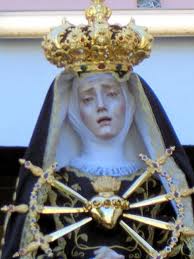
Having been in much suffering because of the privation of my most sweet Jesus, this morning, the day of the Sorrows of Mary Most Holy, after I struggled in some way, He came and told me: “My daughter, what do you want, that you so much yearn for Me?”
And I: “Lord, what You have for Yourself – that is what I yearn for myself”
And He: “My daughter, for Myself I have thorns, nails and cross.”
And I: “Well then, that is what I want for myself.” So He gave me His crown of thorns and shared with me the pains of the cross.
Then He added: “Everyone can share in the merits and in the goods produced by the sorrows of My Mother. One who, in advance, places herself in the hands of Providence, offering herself to suffer any kind of pains, miseries, illnesses, calumnies, and everything which the Lord will dispose upon her, comes to participate in the first sorrow of the prophecy of Simeon. One who actually finds herself amid sufferings, and is resigned, clings more tightly to Me and does not offend Me, it is as if she were saving Me from the hands of Herod, keeping Me safe and sound within the Egypt of her heart – and she participates in the second sorrow. One who feels downhearted, dry and deprived of My presence, and remains yet firm and faithful to her usual practices – even more, she takes the opportunity to love Me and to search for Me more, without tiring – comes to participate in the merits and goods which My Mother acquired when I was lost (third sorrow). One who, in any circumstance she encounters, especially in seeing Me gravely offended, despised, trampled upon, tries to repair Me, to compassionate Me, and to pray for the very ones who offend Me – it is as if I encountered in that soul My own Mother who, if She could have done it, would have freed Me from my enemies; and she participates in the fourth sorrow. One who crucifies her senses for love of My crucifixion, and tries to copy the virtues of My crucifixion within herself, participates in the fifth one. One who is in a continuous attitude of adoring, of kissing My wounds, of repairing, of thanking etc., in the name of all mankind, it is as if she were holding Me in her arms, just as My Mother held Me when I was deposed from the Cross – and she participates in the sixth sorrow. One who remains in My grace and corresponds to it, giving a place to no one else but Me within her heart, it is as if she buried Me in the center of her heart – and she participates in the seventh one.”
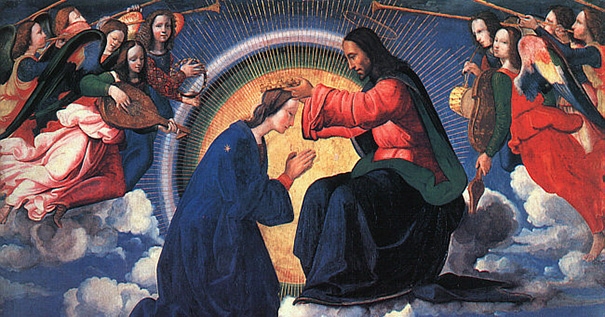
BY MARGE FENELON 08/22/2015
…Yes, Mary’s kingdom is vast, and it includes all of God’s children. That means you and me. She is our Mother, but also our Queen, and as our Queen, we should allow her to reign over our hearts, our work, and our lives…
…On this Feast of the Queenship of Mary (Celebrated August 22nd), perhaps we can re-crown Mary as our heavenly Queen, offering her the honor she deserves and recommitting ourselves to her as her royal subjects. Is there a church or Marian shrine near you? Why not stop in for a quick visit and greet your Queen? Make up a private crowning prayer and symbolically place the golden crown upon Mary’s holy head. You can even do this in the shrine of your heart. Jesus dwells there, and wherever he is, Mary is.
In return, Mary will give you gifts in abundance because it is her special day, and because you are special to her. You are not only her royal subject, but also you are her royal child and she cherishes you as such.
The gifts you receive may not be what you expect, but they will be exactly the ones God wants you to have, through Mary’s royal hands.
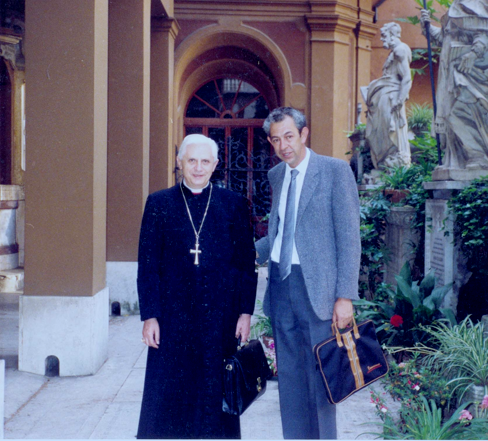
His Eminence and Most Reverend Cardinal Joseph Ratzinger
(Prefect of the Congregation for the Doctrine of the Faith during the Pontificate of His Holiness Pope John Paul II), and José Luis Acuña
Photo provided, and document authored by
Mr. Acuña’s daughter Alejandra Acuña
His Eminence and Most Reverend Cardinal Joseph Ratzinger, Prefect of the Congregation for the Doctrine of the Faith during the Pontificate of His Holiness Pope John Paul II, has been chosen by the Holy Spirit as the Supreme Pontiff of the Holy Roman Catholic and Apostolic Church, precisely in these times in which the Era of the third Divine Fiat begins, as the fulfillment to the petition of the Our Father: ” Adveniat Regnum tuum. Fiat Voluntas Tua sicut in Cœlo et in terra”. And His Holiness Benedict XVI knows about it, as God had prepared him over time making him know and study the writings of Luisa Piccarreta, “The Little Daughter of the Divine Will”, chosen by God for the mission of opening the doors of the Kingdom of the Divine Will on earth as it is in Heaven.
This is the story:
The “Appendix”
It was in the year 1989 when José Luis Acuña (my father), who lived in Atlacomulco, Mexico, gave to his bishop His Excellency Mons. Ricardo Guízar Díaz, the last book of Don Octavio Michelini that he had translated and published: “The Cup is Overflowing”, with an Appendix written by himself. Four years previously, in 1985, when my dad had bought a house in this diocese to live with us his family, he went to greet our bishop and to introduce himself personally, as he had already been in contact with him once, precisely because of the two previous books of Father Michelini translated and published by him; Mons. Guízar had requested these books for priests of the diocese of Aguascalientes, in which he was the auxiliary bishop, before being made the first bishop of the then recently established diocese of Atlacomulco. Since then they had established a spiritual, cordial and respectful relationship; my dad, together with my mom, Marcela Rincón de Acuña, visited him once in a while and took advantage of this to talk to him about the writings of Luisa Piccarreta and give him some of those he had already translated. In August 1986 His Excellency went to consecrate our private chapel, dedicating it to the Virgin Assumed into Heaven, and every August 15th he would celebrate mass in that chapel.
Mons. Guízar thought that the content of the Appendix was up to date and of great importance, and at the end of 1989 when he made his visit “Ad Limina Apostolorum” – visit that every five years every bishop makes to the Holy Father to inform him about the diocese in his charge- he also made an appointment with the Prefect of the Congregation for the Doctrine of the Faith, ex Holy Office, the Cardinal Joseph Ratzinger, talked to him and gave him the Appendix written by my father, one of his diocesans. The Cardinal looked very interested, because before so many problems and attacks to the Church, inside and outside of Her, he wanted to have a more luminous view of the future of the Church, and the Appendix talked about the attacks and problems of the Church, yes, but also that those attacks are originated precisely by the devil and his partisans to impede or delay in the Church and through Her in the whole world, the Establishment of the Kingdom of God on earth as it is in Heaven, purpose for which the Church was founded by Jesus Christ. However:
“God’s decrees are eternal and there is nothing or nobody that can impede them to be carried out. The creation was an eternal decree and nobody was able, is able or will be able to impede it. The Incarnation and Redemption was an eternal decree and there was nobody able to impede Him fulfilling it. In that same way: THE KINGDOM OF GOD ON EARTH AS IT IS IN HEAVEN is an eternal decree, since Jesus Himself, Eternal Incarnate Word of God, announced It asking for It and making us ask for It, and there is nothing or nobody that can impede Him in this. The harm is for whoever doesn’t want to receive the goods and the fruits of the fulfilment of those decrees, but to impede them…nobody, neither the devil, nor the wickedness of the creature, absolutely nothing or nobody!
…There is the Magisterium, received from the same mouth of Jesus: “Thy Kingdom come, Thy Will be done on earth as it is in Heaven” and It will come and It will be done… Guided by the Magisterium of our Holy Mother the Church lets open wide the doors of our hearts to the Redeemer and to the Kingdom of God on earth, on us, in us as it is in Heaven, as we know that this Kingdom is the full fruit of the Incarnation of the Word…” (Appendix)
Interview
Few months afterwards, in May 1990, my parents planned a trip to Italy, to visit the places of Luisa Piccarreta in Corato. Due to the interest shown by Cardinal Ratzinger, my father thought of visiting him in order to tell him more about the Kingdom of the Divine Will in the writings of Luisa; he talked about it with Mons. Guízar and he gave my father a recommendation letter so that Cardinal Ratzinger could receive them.
Once in Italy, they first went to Corato to the House of Luisa, see of the Association “Luisa Piccarreta” founded by Sister Assunta Marigliano; they had an interview with the Archbishop of Trani, Mons. Giuseppe Carata, who had recognized and approved three years before, the Pious Association, and they told him that in Italy they were going to visit His Eminence Cardinal Ratzinger. Mons. Carata told them some interesting facts so that they could mention them to the Prefect Cardinal: that soon they were going to beatify the Venerable Father Annibale Maria Di Francia, Luisa´s extraordinary confessor, Ecclesiastical Censor of the writings of Luisa and first editor of “The Hours of The Passion”, which were published under his responsibility and with his own name, making several editions in Italian and then translated into German and had been placed in the Index of Forbidden Books, and now…. they were going to beatify him?
In the Vatican, my parents were admitted into the private mass of Cardinal Ratzinger and afterwards they approached him. My father as soon as he came out of that interview briefly wrote the main ideas treated with His Eminence:
More or less these were the main ideas. He thanked me and said that I should continue to do everything with the Bishop. I said goodbye.
After that I waited for him outside the chapel to take a picture with him, to put it in the chapel, to which he gladly agreed. I repeated that what pertained to Luisa was VERY IMPORTANT for the Church. He gave us his blessing and we said goodbye.
In the street I met once again the Personal Secretary, to whom I also spoke about Luisa, who didn’t know, now he knows about her…I will be able to write to him, giving them more writings.